
Corner Country Explorer
23 June 2026
21 July 2026
18 August 2026
1 September 2026
22 September 2026
‘Walk Like an Egyptian’ on this captivating 17-day journey to Egypt, including a three-night Nile cruise and experience of a realm of mystique and marvels that has enthralled travellers for millennia. Step back in time as you explore the iconic Pyramids of Giza, behold the Sphinx, the guardian of mysteries, discover the temples of Abu Simbel, Karnak, Kom Ombo and Dendera and explore the tombs in the Valley of the Kings. Pay your respects at El Alamein War Cemetery, a memorial that commemorates almost 12,000 Commonwealth forces members who died during World War II.
Welcome to Cairo! You’ll be met at the airport and transferred to our hotel overlooking the Great Pyramids.
Our tour kicks off with a Welcome Dinner and drinks scheduled for around 6.00pm, so when booking your flights, please consider your arrival time to ensure you don’t miss out on this fully-hosted opportunity to meet your tour leaders and fellow travellers.
If you’d like to arrive a little earlier in Cairo and take advantage of our special hotel rate, or would like some assistance with flight bookings, please reach out to our office on 1300 800 977.
Overnight: Marriott Mena House, Cairo or Similar (D)
This morning, after breakfast, you’ll get up close with the world’s most iconic landmarks, the Pyramids of Giza and the Sphinx. Standing 138 metres tall, the Great Pyramid of Giza, built for Pharaoh Khufu (2589–2566 BC), is the oldest of the Seven Wonders of the Ancient World and the only one still largely intact. Nearby, the 73-metre-long Sphinx, with its awe-inspiring dimensions and enigmatic presence, remains one of the most recognisable statues in history. We’ll have the whole morning here, so there’ll be plenty of time to explore these 4,500-year-old structures.
After lunch togethers, we’ll explore the new Grand Egyptian Museum (GEM), the world’s largest archaeological museum dedicated to a single civilisation. After decades of planning, this magnificent building, architecturally inspired by the pyramids, was officially opened in July 2025. It spans 490,000 square metres, and houses over 100,000 artifacts from ancient Egypt, including the complete Tutankhamun collection, with many pieces on display for the first time.
You’ll have as much time here as you want as the rest of the afternoon and dinner tonight is at leisure, so you may wish to stay on at the Museum and eat in one of the great cafes located there. Our hotel is only a short distance away.
Overnight: Marriott Mena House, Cairo or Similar (B,L)
After breakfast and checking out, we’ll board our private coach and transfer to the Giza Metro station to experience travel the way the locals do it across to the East Bank and downtown Cairo. Opened in 1987, the Cairo Metro was Africa and the Middle East’s first metro network and the first rapid transit system on the continent and in the Arab world. Leaving our luggage with our coach, we’ll travel across the Nile by local metro to Coptic Cairo and begin our exploration of Old Cairo on foot.
Coptic Cairo was a stronghold of Christianity in Egypt and its believed the Holy Family sought refuge in a cave here after fleeing into Egypt, over which the Saints Sergius and Bacchus Church (Abu Serga Church) was built in the 4th Century. Other highlights include The Hanging Church, dating back to the 3rd century; the Coptic Museum, home to the largest collection of Coptic Christian artifacts in the world; and Ben Ezra Synagogue, famous for the discovery of the “Geniza documents”, a treasure trove of Jewish historical texts.
After lunch in a local restaurant, we’ll jump back on the Metro to explore nearby historic Islamic Cairo, known for its stunning mosques, madrasas (Islamic schools), and bustling markets – one of the world’s richest areas in Islamic architecture, reflecting the grandeur of the Fatimid, Mamluk, and Ottoman periods.
Islamic Cairo is also home to the vibrant, bustling Khan El Khalili Bazaar, Cairo’s famous souq founded in 1382 during the Mamluk era by Emir Dajaharks Al-Khalili. Originally a major trade center for merchants from around the world, it features traditional Mamluk-style architecture with narrow alleyways, old mosques, and historic khans (caravanserais). You’ll have time to browse and explore this amazing place.
After regrouping for coffee and a snack, we’ll make our way to the modern Bashtil train station to board the Watania Sleeper Train to Aswan, 900 kilometres south.
Dinner tonight will be served in your cabin.
Overnight: Watania Sleeper Train from Cairo to Aswan (B, L, D)
If you’re an early riser, you’ll be rewarded this morning with a serene view of the sunrise over the Nile River from your sleeper cabin window. After arriving at Aswan train station in the mid-morning, we’ll transfer directly to the Nubian Museum, a UNESCO funded testament to the culture and communities that were lost when historic Nubian land was flooded to create Lake Nasser during the construction of the Aswan High Dam in the 1960’s.
Nubia, once located in present-day southern Egypt and northern Sudan, was home to some of the earliest civilizations in Africa and played a crucial role in trade, politics, and cultural exchanges along the Nile River, until the decision to flood the communities resulted in the displacement of around 100,000 Nubians from their ancestral lands and disrupted centuries-old Nubian culture. Although UNESCO launched a massive campaign to relocate major temples like Abu Simbel, many smaller historical sites were lost forever.
From here, we’ll transfer by river boat to our resort-style hotel located on Elephantine Island in the middle of the River Nile, and enjoy lunch before checking in. After settling into your room, some downtime exploring the hotel’s gardens or relaxing with a drink on the sun-drenched terrace.
Tonight, we’ll jump on a river boat and visit the iconic Old Cataract Hotel, a historic British colonial-era masterpiece built in 1899 by Thomas Cook, for dinner. Overlooking the Nile, the hotel has hosted luminaries such as Winston Churchill, Agatha Christie, and Princess Diana, and was famously featured in Christie’s Death on the Nile.
Overnight: Sonesta Nouba Hotel, Aswan or Similar (B, L D)
This morning after breakfast, we’ll visit Philae Temple and the Unfinished Obelisk. On the way, we’ll stop off at the Aswan High Dam, a marvel of modern engineering. Completed in 1970 under President Gamal Abdel Nasser, the dam created Lake Nasser, one of the world’s largest artificial lakes, and controls the Nile’s flooding cycle and generates hydroelectric power. Its construction was not without controversy, requiring the relocation of thousands of Nubians and significant cultural landmarks like Abu Simbel. The dam also became a geopolitical flashpoint during the Cold War, as Egypt’s decision to partner with the Soviet Union over the United States and United Kingdom reshaped global alliances.
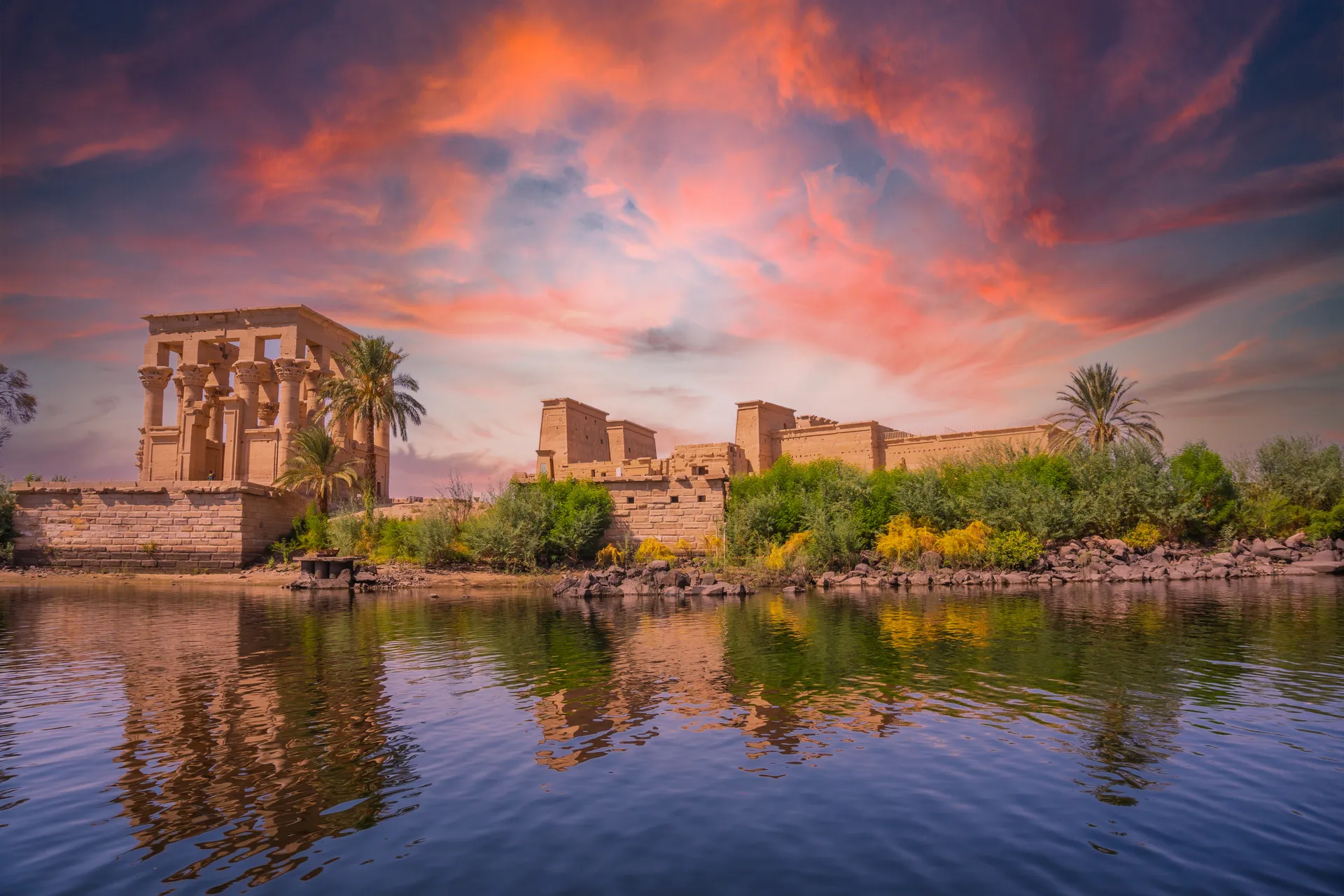
The Philae Temple, one of Egypt’s most beautiful and well-preserved temples, is dedicated to Isis, the goddess of love, motherhood and magic. Built on Philae Island during the Ptolemaic Dynasty (305–30 BC), with later additions by the Romans, it was painstakingly moved, piece by piece, and reconstructed at its current location when construction of the Nasser Lake and the Aswan High Dam threatened its existence. Along with Abu Simbel, it was saved from obliteration by a global movement in the 1960s funded by UNESCO to save the great temples of Egypt.
The Unfinished Obelisk, one of the most fascinating ancient monuments in Egypt and the largest known obelisk ever attempted to be built by the ancient Egyptians. Commissioned during the reign of Queen Hatshepsut (1478–1458 BC), it was intended to be a monumental obelisk, likely for the Temple of Karnak. Had it been completed, it would have stood at 42 metres tall and weighed around 1088,622 tonnes, making it the largest obelisk in the world – and all carved from a single piece of stone. While carving the obelisk directly from the bedrock, cracks appeared in the granite, making it unusable, and the project was abandoned, to be uncovered in a quarry many years later.
We’ll return to the hotel in time for lunch at leisure, after which the afternoon is yours to relax. There will be a chance to visit the Aswan Local Market, Sharia el Souk, and a specialist Egyptian cotton store for those wanting to buy some mementos.
Tonight we’ll enjoy dinner at a local restaurant.
Overnight: Sonesta Nouba Hotel, Aswan or Similar (B, D)
After an early breakfast and check-out, we’ll hand our luggage over to our coach driver and transfer to the Aswan airport for the short flight to Abu Simbel to explore one of Egypt’s most iconic archaeological sites – two massive rock-cut temples built by Pharaoh Ramses II in the 13th century BCE. The main temple, flanked by the iconic huge external rock relief figures of Ramesses II is a sight to behold and the smaller one is dedicated to Ramses II’s wife, Queen Nefertari, and the goddess Hathor. The saving and relocation of the Abu Simbel complex in a massive UNESCO-led project prior to the flooding of Nubia is considered one of the greatest archaeological engineering and rescue feats in history. Over four years between (1964-1968), the temples were cut into 1,050 blocks, each weighing up to 30 tons; painstakingly moved 65 metres higher and 200 metres back from their original location; and faithfully reconstructed to maintain their original alignment with the sun.
Upon arrival back at Aswan airport, our private coach will transfer us to our Nile Cruise. After checking in to our cruise boat, we’ll enjoy lunch onboard, before settling into the next chapter of your Nile adventure – three nights gliding along one of the world’s most incredible rivers. Enjoy all the comforts of a premier hotel, including a swimming pool, sundeck, restaurant and cabins with panoramic windows to watch riverside life stream in between your off-boat excursions.
Overnight: MS Farah Cruise or Similar (B, L, D)
Today is yours to relax on board until later in the afternoon when we arrive at our first destination, Kom Ombo Temple. This unique second-century BC complex, built during the Ptolemaic period, is dedicated to two deities – the crocodile god Sobek and the falcon god Horus. Kom Ombo’s walls have some of Egypt’s oldest medical texts, including surgical instruments and treatments, and features one of the earliest Egyptian calendars, showing a 365-day cycle. A Crocodile Museum next to the temple displays mummified crocodiles, reflecting the worship of Sobek.
After marvelling at the cleverness of such an ancient civilisation, you’ll return to your boat and enjoy dinner as we cruise upriver, taking in views of desert hills, verdant riverbanks, fishermen casting nets, and farmers tending their fields.
In the evening, the ship will dock near the Temple of Edfu.
Overnight: MS Farah Cruise or Similar (B, L, D)
Today is a relaxing day along the river with on-board activities as we sail onwards to Luxor, enjoying lunch before we pass through the famous Esna Lock, a lock and dam system built in 1908. Due to the narrow passage, ships often have to queue to proceed through the locks, and you’ll have a great opportunity to check out the process from the deck with a cold drink in hand, listening to the shouts of the many ship captains as they navigate their way through hordes of small boats of merchants selling their wares to a captive audience!
Upon arrival in Luxor, we’ll embark on a late afternoon exploration of the magnificent Luxor Temple. Gracefully illuminated as the day fades, this extraordinary riverside sanctuary reveals its grandeur at its most atmospheric. Built and expanded over many centuries, it was the ceremonial heart of ancient Thebes, closely linked to the great Karnak Temple by the Avenue of Sphinxes. Walk between towering columns and beautifully carved reliefs that depict royal rituals and offerings to the gods, and notice later layers of history woven into the site, from Roman-era additions to the enduring presence of Egypt’s living city beyond its walls.
Return to your ship for dinner and a relaxing evening moored in Luxor.
Overnight: MS Farah Cruise or Similar (B, L, D)
After an early breakfast and checking out, our private coach will take us directly to the Valley of the Kings – the awe-inspiring UNESCO World Heritage site. Home to over 60 tombs, including those of pharaohs like Tutankhamun and Seti I, the valley’s intricate hieroglyphs and vivid wall paintings tell stories of their reigns. Your expert Guide will explain the history and legends of these remarkable people and the significance of the many paintings and hieroglyphics, still well preserved in the deepest tombs before continuing to the mortuary Temple of Queen Hatshepsut – an architectural feat with three grand terraces set against desert cliffs.
From here we’ll visit a local Alabaster workshop, where you’ll learn the difference between a handmade and machine made product (very handy if you are wanting to buy a piece) and see artisans at work. Our next stop is the nearby Colossi of Memnon – two 17-metre-high stone statues of the Pharaoh Amenhotep III, which stand at the front of the ruined Mortuary Temple of Amenhotep III, the largest temple in the Theban Necropolis.
After a busy morning, we’ll visit the home of a local family for a delicious lunch and experience a small part of local Egyptian life before heading to our hotel to check in.
The rest of your day and evening is at leisure. There are many excellent restaurant choices in and close to your hotel for dinner – just ask your tour leader for some recommendations.
Overnight: Steigenberger Nile Palace Hotel, Luxor or Similar (B, L)
This morning, we return to the West Bank for an ‘off the beaten track’ experience – visits to the remarkable Medniet Habu and Deir el-Medina.
At Medinet Habu, enjoy the lack of tourists as you explore the vast mortuary temple of Ramesses III, celebrated for its fortress-like walls, soaring pylons and exceptionally well-preserved reliefs that vividly depict ritual processions and royal campaigns.
Our Valley of the Kings story continues with Deir el-Medina, the village that was once home to the artisans and master builders who worked on the royal tombs. The archaeological work that has been completed here has resulted in one of the most thoroughly documented accounts of community life in the ancient world that spans almost four hundred years. There is no comparable site in which the organisation, social interactions, working and living conditions of a community can be studied in such detail. Here, again without large tourist groups, you’ll discover beautifully decorated tomb chapels and gain a more personal insight into daily life, beliefs and craftsmanship in ancient Thebes, revealed through the workers’ homes, shrines and enduring painted scenes.
Return to the hotel after midday, with the rest of the day yours to stay in the hotel around the pool or spend a leisurely day exploring Luxor at your own pace. Wander through the bustling souks, where vibrant stalls overflow with spices, handcrafted jewellery and colourful textiles. Maybe visit the Luxor Museum, home to beautifully preserved artefacts, or relax along the Corniche, watching feluccas glide across the Nile.
Overnight: Steigenberger Nile Palace Hotel, Luxor or Similar (B)
This morning, after breakfast, we’ll travel by local rail through scenic Nile villages to Qena, before continuing by coach to the Temple of Dendera, also known as the Temple of Hathor, built primarily during the Ptolemaic and Roman periods (305 BCE–250 CE). Hathor is an important ancient Egyptian goddess associated with love, beauty, music, dance, joy, motherhood, fertility, and was considered a protector of women and children. Rarely visited by tourists, Dendera is considered to be one of the best-preserved temples in Egypt and one of the few where the richly decorated reliefs and columns remain incredibly intact.
We’ll return to the hotel in the early afternoon, where you’ll have a few hours of leisure to relax or explore more of Luxor.
This evening is very special – dinner at the Old Winter Palace Hotel, now part of the Sofitel chain. Built in 1886, this historic British colonial-era hotel located on the banks of the Nile has hosted a number of famous figures, including Howard Carter, who made the groundbreaking discovery of Tutankhamun’s tomb while staying there, and Agatha Christie who wrote much of “Death on the Nile” while staying there.
Overnight: Steigenberger Nile Palace Hotel, Luxor or Similar (B,D)
This morning after breakfast and check-out, visit the majestic Karnak Temple, the sprawling complex dedicated to the god Amun, among other deities like Osiris and Isis. Renowned as the largest religious structure in the world, Karnak Temple showcases Egypt’s architectural grandeur and spiritual devotion, enriched by the contributions of numerous pharaohs who sought to immortalise their legacies through magnificent additions to this awe-inspiring site. Highlights of your visit include the Great Hypostyle Hall with its 134 towering columns, intricately carved pylons, massive obelisks, and the Avenue of Sphinxes, which once linked Karnak to Luxor Temple.
Next, transfer directly to the airport for a short noon flight to Cairo. On arrival, we will transfer directly to your hotel for check-in.
The rest of the afternoon and dinner tonight is at leisure.
Overnight: Kempinski Nile Hotel, Cairo or Similar (B)
This morning after breakfast we’ll head out for a morning exploring more of Egypt’s fascinating history, starting with a guided tour of the Egyptian Railway Museum, celebrating one of the oldest railway networks in the world. The first ever railway in Africa and the Middle East was built in Egypt in 1853, travelling between Alexandria and the Delta region, eventually expanding to Cairo in 1856 with the opening of the Ramses Train Station. While the prize of the collection is undoubtedly the locomotive built for French Empress Eugénie on the occasion of the opening of the Suez Canal in 1869, the museum also traces the history of transportation in Egypt from the Pharaonic era to the modern-age, utilising a series of models, replicas, documents and old photos.
Our next stop will be the National Museum of Egyptian Civilization, one of Egypt’s most significant museums, offering a comprehensive look at Egyptian history from prehistoric times to modern-day Egypt, and home to The Royal Mummies Hall, where you’ll have the privilege of seeing mummified pharaohs in a special underground chamber – the only place in Egypt that enables such a memorable experience.
The rest of the day is yours – you may wish to return to the hotel or stay on and explore more of Cairo at your own pace, enjoying some lunch at a local cafe.
Dinner tonight will be in a local restaurant.
Overnight: Kempinski Nile Hotel, Cairo or Similar (B, D)
This morning after an early breakfast and check out, we’ll hand over our luggage to our private courier and transfer to the train station to board the 8:00am Talgo fast train from Cairo to Alexandria, the home of Cleopatra, and Egypt’s second largest city, often referred to as the Pearl of the Mediterranean. Built by the Greek architect Dinocrates in 331 BC under the orders of Alexander the Great, the city quickly flourished into a prominent cultural, intellectual, political and economic metropolis. At one time, Alexandria was the second-most powerful city of the ancient Mediterranean region, after Rome.
Upon our mid-morning arrival, our private coach will meet us and take us on a tour of Alexandria – the highlight being the chance to venture underground to the famous Catacombs of Kom ash-Shuqqafa, an ancient Roman burial site dating back to the second century, remaining undiscovered until 1900.
We’ll stop for lunch and then this afternoon is yours to explore your surroundings. You might stroll through a local market, enjoy a refreshing stop at the historic Farouk Café (opened in 1928 and named after King Farouk), or walk along the Corniche to admire the boats in the harbor.
Dinner tonight is at leisure.
Overnight: Steigenberger Cecil Alexandria, Alexandria or Similar (B, L)
This morning after breakfast, we’ll journey southwest of Alexandria to the historic battle site of El Alamein. Here, three major battles between July and November 1942 marked a turning point in World War II in North Africa. The Australian 9th Division, under the command of Lieutenant General Leslie Morshead, played a key role in two of these crucial battles, further cementing its reputation from the defense of Tobruk in Libya in 1941. The Axis forces, made up of German and Italian troops led by the legendary Field Marshal Erwin Rommel were opposed by the British Eighth Army, led by General Bernard Montgomery, consisting of troops from Britain, Australia, New Zealand, South Africa, and India. The eventual Allied victory in El Alamein was decisive, shaping the course of the North African campaign. However, the battle came at great cost, and the memorial at El Alamein commemorates nearly 12,000 Commonwealth servicemen who died in the Western Desert campaigns of World War II.
You’ll have plenty of time to reflect on the sacrifices our troops made, explore the history and significance of the battles, and pay your respects at the Memorial to the Australian 9th Division before enjoying a relaxing lunch at a local restaurant, and arriving back at our hotel in the mid-afternoon.
After some time to freshen up, those that are interested might like to embark on a unique tour of the undiscovered suburbs of Alexandria by heritage tram with your Tour Leaders. The Alexandria Tram is one of the oldest tram networks in the world and the oldest in Africa, dating back to 1860 and still serving the people of Alexandria.
Alexandria is known for its seafood and tonight we will enjoy a memorable seafood dinner on the waterfront at the White & Blue Greek Nautical Club, where the fresh Mediterranean air adds to
the experience.
Overnight: Steigenberger Cecil Alexandria, Alexandria or Similar (B,L,D)
This morning after breakfast, checking out and leaving our luggage with our private courier, we’ll spend some time exploring more of Alexandria with visits to the Bibliotheca Alexandrina (the modern Alexandria Library) and the nearby Roman Theatre.
The ancient Library of Alexandria was one of the most famous libraries in the ancient world, serving as a centre for learning, science, and philosophy, counting Eratosthenes, Archimedes, and Euclid among its students. Established in the 3rd century BCE, it flourished under the rule of the Ptolemaic dynasty, aiming to collect all the world’s knowledge, making it a symbol of intellectual achievement. At its height, it contained up to 400,000–700,000 scrolls, making it the largest library of its time. Its destruction remains one of history’s greatest losses. The Bibliotheca Alexandrina, the Modern Alexandria Library, was built to revive the spirit of the ancient Library of Alexandria. Opened in 2002 and located near the site of the ancient library, the new library is a hub for knowledge, science, and culture, housing millions of books, manuscripts, and digital archives.
The nearby Roman Theatre is a remarkable archaeological site that showcases the city’s Roman period) and is one of the few Roman theatres to be found in Egypt. It offers a fascinating glimpse into the cultural and social life of Alexandria during the Roman Empire, with the area you’ll visit including the Villa of the Birds, named for the beautiful mosaic floor that depicts various birds in stunning detail.
We’ll arrive at the Alexandria train station in time to buy some snacks to enjoy on board before we head back to Cairo. Upon our arrival, we’ll transfer directly to our hotel for some time to relax and freshen up before our celebratory farewell dinner including drinks at a nearby local restaurant.
Overnight: Kempinski Nile Hotel, Cairo or Similar (B, D)
Our tour ends after breakfast this morning. Transfers to the airport are included and will be scheduled to accommodate your flight booking.
(B)
12 nights’ accommodation in the highest quality hotels available, mostly 5 stars
1 night on the Watania Sleeper Train
3 nights’ accommodation on a premium Nile Cruise
Full breakfast daily, 9 lunches, 11 dinners
Drinks included with welcome and farewell dinners
Australian Railway Adventures tour leader throughout
A local tour manager/tour guide for the duration of the journey
The best seats possible on all train journeys in modern air-conditioned day trains
Private air-conditioned vehicle transfers for road travel
All excursions and entrance fees to attractions, as listed in the itinerary, including all internal flights
Airport transfers on arrival and departure
All service gratuities and tips for guides (valued at $500 per person)
Travel to and from the tour
Meals and services not mentioned in the itinerary
Egyptian tourist visa
All other personal expenses, such as drinks, phone calls, laundry services, and camera fees where applicable
Excursions listed as optional and extra in the itinerary
Travel Insurance (a condition of travel)
The best train trips possible, private luxury coach for off-train travel, guided walking where suitable, and other appropriate and appealing options to make exploration easy
Hand-picked hotels and resorts based on location, customer feedback, value and atmosphere. Please Note: Hotels of a similar standard may be substituted.
Hear from some of our adventurers that have already ridden the rails with us.
Lorem ipsum dolor sit amet consectetur. Tincidunt convallis magna eu ac eu cursus. In duis fusce risus nec eget habitant massa pharetra. Eros a gravida faucibus lorem.

Reserve your place on this exciting exploration of Egypt by Train, Boat & Plane.

Train traveller, well known TV personality and travel company owner, Scott McGregor, has travelled on some of the world’s most inspiring railway tours and led the most exclusive group adventures to numerous exotic destinations over the years.
“Rustic, character-filled, zig-zagging railways of Burma, opulent hotels on wheels in India South Africa and Sri Lanka, steam-hauled heritage trains in some of the most staggeringly scenic parts of the world, dinky little rail-cars in outback Queensland, bullet trains in Japan, cliff-hugging lines in Switzerland and Norway—if it travels on a rail track, I’m there!”, exclaims self-confessed train travel tragic, Scott McGregor. “In my mind, travelling by rail is still the most wonderful way to immerse yourself in the country you’re visiting. It’s romantic, relaxing and about as much fun as you can have!”.
Aa a child of the last days of steam trains in the busy junction town of Orange, NSW; trains heading in all directions offering temptations and dreams of faraway places, left an indelible impression on a young, inquisitive boy and Scott has been riding the rails in one form or another ever since. While Scott’s acting career of 30 years kept him busy starring in numerous TV shows and stage plays and then as an on-air presenter on programs such as Better Homes and Gardens, Room for Improvement and various pay-TV programs, his passion for railway tours was ever-present. “Presenting a series of Railway Adventure travel programs for Channel 7 was a career highlight”, he says with as much enthusiasm now as he had then.
In 2012 Scott decided to combine three of his passions; travel, trains and presenting, and launched Railway Adventures. Not only does he get to expand his own horizons and indulge his love of train travel, he gets to use his extensive hosting experience and love of people to lead other like-minded travellers on escorted train tours around the world. Since then, Railway Adventures has mounted more than 50 tours from Sweden to Sri Lanka, Tasmania to Transylvania, Britain to Burma and Venice to Vietnam, thrilling over 1,000 travellers. New tours are launched regularly, inspired by new trains, new routes and the growing interest in taking a train to some of the world’s most fascinating places. But you don’t have to be a train ‘nut’ to enjoy a Railway Adventures tour – there’s something for everyone!
Just one example of how Scott finds inspiration for a tour can be found in Outback Queensland. “There you find some of Australia’s most eccentric and appealing trains and together with a mail-plane flight over the Gulf and some interesting local coach and boat trips you have the essence of a quintessential Aussie outback adventure. The sleeper train, The Spirit of the Outback, the Savannahlander and the Gulflander (which has been running on the same timetable for more than 125 years!) are all iconic trains that traverse various parts of the wild Outback, Savannah and tropical rainforest landscapes of the vast state of Queensland. Along with some other special treats not available to the ordinary traveller, Railway Adventures passengers get to do it all!.
One of his favourite journey’s is by private train in Sri Lanka. For 2 weeks every year Scott charters the Viceroy Special heritage train to tour the island on a gentle rail cruise with a lucky group of travellers. Staying in luxury resorts and hotels along the way, his special train travels to almost every corner of the scenic island. “Having a private train at your disposal for an adventure around this magic island is a rare treat and a great way to immerse yourself in the scenery and culture of the country.”, he enthuses. “Our Vietnam tour makes use of private carriages attached to regular trains to explore that great country in comfort and in South Africa we use a variety of trains including the luxurious Rovos Rail and the Royal Livingstone steam train to move from one incredible adventure to another”.
Apart from the obvious joy of seeing a country by train, travelling in a small group of like-minded travellers with a dedicated, experienced tour leader and knowledgeable, English-speaking local guides is what really sets Railway Adventures apart. “The camaraderie that comes from both shared purpose and shared experiences on tour is an important aspect of the journey” Scott adds. “We’ve seen many people become life-long friends from the time they shared together along the line. The best feeling in the world is when I welcome these same people on repeat journeys”.
Along with popular destinations like Switzerland, Scandinavia, Outback Queensland and Sri Lanka, a new breed of more unusual destinations has gained great interest. Java, Cuba, Southern Africa, India and the New England region of NSW are just some of the newer adventures on offer. As for Scott’s next escape, it’s most likely some quality time at Ruwenzori Retreat, his own personal train on the Great Dividing Range near Mudgee, Central NSW. Built from a collection of vintage railway carriages it’s now a boutique tourist accommodation, comprising exclusive Orient Express style comfort for up to 13 guests. “When the travels are done, coming back to my own train in the beautiful Mudgee mountains is the most restorative and magical time for this committed rail romantic”, Scott says.