
Great Southern Heritage Rail Adventure
• SYDNEY • TARANA • PARKES • BROKEN HILL • PETERBOROUGH •
• PORT AUGUSTA • QUORN • WILPENA POUND • HAWKER • PORT GERMEIN •
• LOCHIEL • SEVENHILL • ADELAIDE • MOUNT BARKER • STRATHALBYN • GOOLWA •
• VICTOR HARBOR • MOUNT LOFTY • SERVICETON • HORSHAM • MELBOURNE •
• LANGWARRIN • ALBURY • WALLA WALLA • GUNNING • GOULBURN • SYDNEY •
Next
Departure
- Overview
- Highlights
- Map & Itinerary
- Trip Inclusions
- Transport & Accommodation
- Things you need to know
- Reviews
- FAQs

Meet your Tour Leader
Karl Chapman
Karl hails from the north-western home counties of England, an area known to London Underground history buffs as Metro-land for its connection with the Metropolitan Railway in the early 20th century. With a passion for all modes of transport, from…

Meet your Tour Leader
Richard Boyce
Richard grew up in Northwest NSW and went to school in Sydney, travelling many times on the then Northern Tablelands Express, cementing a lifelong love of trains. He worked for some years for a local cruise line and later for…
Step aboard the most extensive and wide-ranging Australian rail tour we’ve ever offered - an unforgettable, fully-escorted, 17-day road and rail odyssey that weaves together the soul of three states - New South Wales, South Australia, and Victoria. You’ll travel on iconic local services and enjoy private charters of heritage trains. You’ll travel all the way from Sydney to Broken Hill by private heritage rail motor, enjoy a private charter on the Pichi Richi Railway, ride the “Red Hens” and Steamranger in South Australia, enjoy a private carriage on The Overland to Bordertown, travel between Horsham, Melbourne and Albury in carriages that once served the iconic ‘Spirit of Progress’, and come back to Sydney on your very own privately-chartered steam-hauled train from Goulburn to Sydney. Add in exclusive off-train excursions, country pubs, fine-dining restaurants, railway heritage buildings, and numerous meal inclusions, each day will make new memories.
Departure dates
Per person twin share: $13,985
Single Supplement: $1,475
Some highlights of your tour
- A private visit to the Sydney Bus Museum followed by an exclusive welcome dinner and drinks in a restaurant housed in a historic building on the Balmain waterfront
- Travel by privately chartered heritage rail motor 621/721 from Sydney to Parkes and on to Broken Hill
- Comprehensive touring in Broken Hill
- Enjoy sundowners at the world famous Living Desert & Sculptures installation outside Broken Hill
- A private charter on the Pichi Richi Railway from Quorn to Port Augusta
- Full day exploring the Flinders Ranges with Adnyamathanha indigenous guides
- Enjoy lunch in the Clare Valley at the award winning Chefs Hat Restaurant ‘Slate’ at Pikes Wines
- Ride the heritage “Red Hens” trains from Mount Barker to Strathalbyn
- Travel aboard the “Cockle Train” from Goolwa to Victor Harbor
- Travel in a private carriage on ‘The Overland’ from Adelaide to Bordertown
- Travel aboard the former ‘Spirit of Progress’ from Horsham to Melbourne and again from Melbourne to Albury
- Visit Dame Elizabeth Murdoch’s garden at Cruden Farm
- Visit Morgans Lookout and enjoy an exclusive visit to Walla Park, hosted by the 5th generation owners
- Revel in an exclusive, privately-chartered steam-hauled heritage rail journey from Goulburn to Sydney
Upon arrival in Sydney make your way to the hotel and check in. Check in is available from 2.00pm.
You’ll meet your tour leaders and fellow travellers in the hotel foyer at 4pm ahead of our welcome drinks and dinner, so when booking your flights, please consider your arrival time to ensure you don’t miss out.
After gathering in the hotel foyer, we’ll walk next door to Central Station to board our privately chartered heritage buses for the short transfer for a private visit of a unique and rather hidden attraction in Sydney’s inner west – the Sydney Bus Museum. With a welcome glass of cheer in your hand, you’ll enjoy perusing this spectacular collection of historic vehicles spanning over a century of transport.
From here, our heritage buses will transfer us to the nearby Balmain waterfront for our welcome dinner at the marvellous restaurant, The Fenwick. Set within an 1880s stone building that was home to the J. Fenwick & Co Boat Store, this remarkable venue blends heritage with contemporary dining and sweeping views from Barangaroo to the Harbour Bridge – a uniquely Sydney experience.
If you’d like to arrive in Sydney earlier, pre-tour accommodation at our hotel can be easily arranged by contacting our office on 1300 800 977 or info@railwayadventures.com.
Overnight: Mercure Sydney Central, Sydney (D)
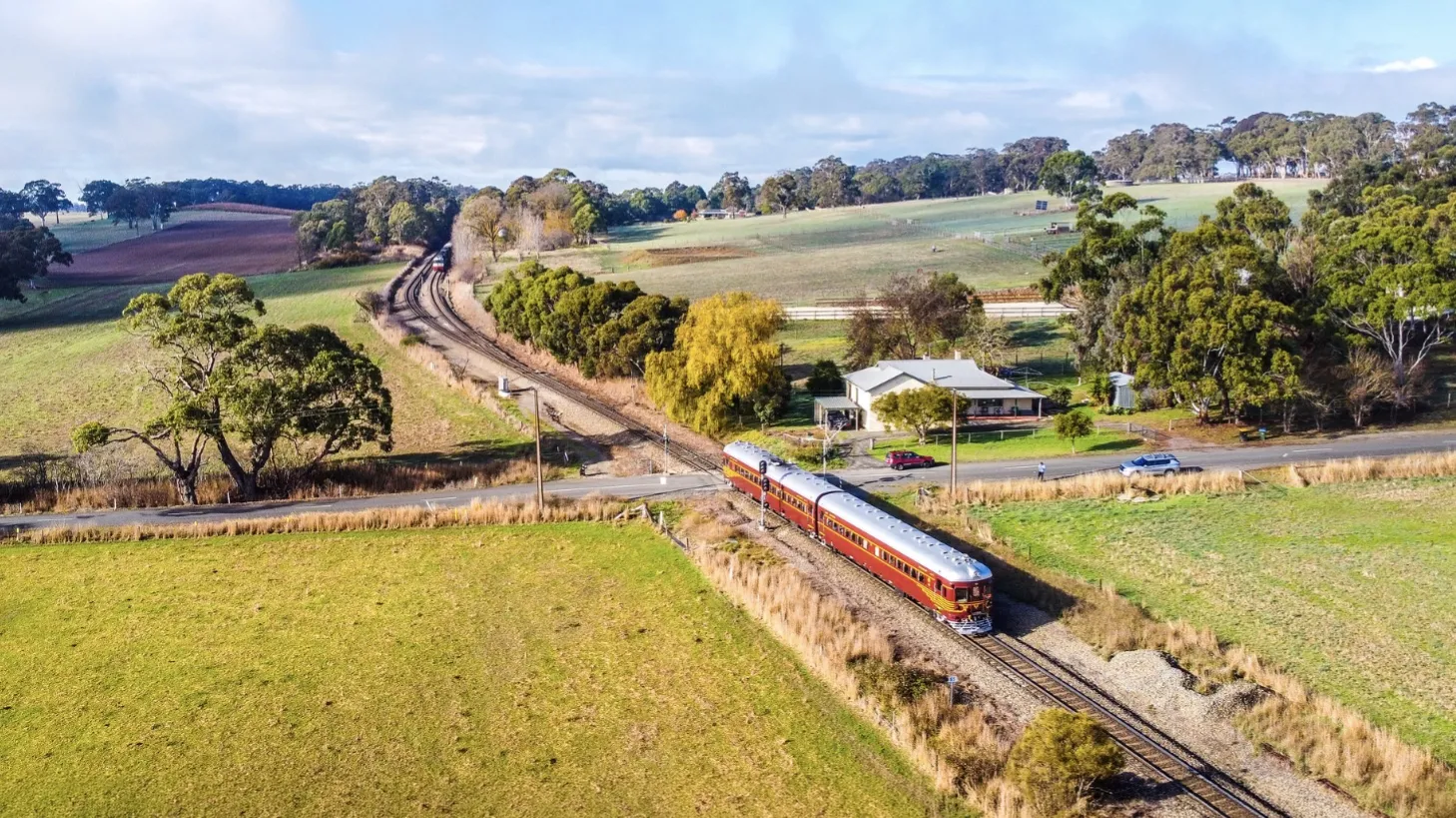
This morning after breakfast and check out, we’ll walk to Sydney’s grand Central Station for the first of our great train journeys – 445 km on a private charter of the 1961 built heritage rail motor 621/721. This compact and comfortable two car set spent most of its career in the Hunter Valley running endless commuter services. With windows that fully open you’ll be beautifully connected with the passing countryside.
Once out of Sydney, we’ll climb into the Blue Mountains, watching as the views become more and more spectacular, to the highest point on the line – Mount Boyce, named in April 1923 in honour of Venerable Archdeacon Francis Bertie Boyce, an Australian clergyman and social reformer who campaigned for the early closing of pubs, the provision of pensions and with his good friend Edmund Barton, the establishment of Empire Day. From here, the land drops sharply in cliffs and steep slopes to the Kanimbla Valley to Lithgow where we’ll cross the historic Farmers Creek viaduct at Bowenfels. The original 1870 sandstone single track viaduct, which you’ll be able to see out the window, is bypassed by a double track brick structure opened in 1921. Between Rydal and Tarana the line makes a spectacular loop around a valley turning almost 360 degrees before heading further west.
We’ll disembark at Tarana and literally walk to the pub for lunch. Established in 1873 the walls are adorned with historical photos, saddles and local artifacts, reflecting its long history. Back on our train, we’ll continue west passing a point of interest just past Blayney – the remains of the once busy Blayney to Demondrille Line, which once connected the Main West Line to the Main South Line via Cowra.
After arriving in Parkes, our home for tonight, in the late afternoon, we’ll transfer directly to our hotel to check in. After some time to freshen up, we’ll head into town for dinner at the historic Railway Hotel.
Overnight: North Parkes Motel, Parkes (B, L, D)
This morning after breakfast and check out, it’s back to the station and our waiting rail motor that will take us far away from the main roads as we journey almost 700 km west to the outback mining town of Broken Hill on the Main Western Line. This line is relatively recent in the history of the NSW railways, only being completed in 1927 and is the route of the regular NSW Train Link passenger service from Sydney to Broken Hill, as well as being part of the famed Indian Pacific transcontinental journey. Sit back and relax as you watch the farming plains slowly morph into the vast scrub of outback NSW.
Around lunch time we’ll arrive at the tiny outpost of Euabalong West, founded in the 1870s as a crossing place of the Lachlan River – the population is around 70 on a good day – and disembark for a quick transfer by private coach to nearby Euabalong for lunch at the Royal Hotel with its classic low, wide verandah along the street.
Back on board our train we’ll continue through vast farming areas which slowly transition to desert. Ahead of arriving into Broken Hill in the early evening, we’ll skirt the famous Menindee Lakes, a series of shallow, man-made water storage lakes on the Darling River. Originally natural ephemeral temporary depressions that filled during floods and dried out in between, the NSW Government modified them with levees, dams, and channels in the 1960s to turn them into a major regulated water storage system to supply Broken Hill and support the wider Murray Darling system. When full, they hold about 1,731 gigalitres, equivalent to more than three and a half times the volume of Sydney Harbour.
Upon arrival in Broken Hill we’ll say goodbye to our rail motor and wonderful crew, many of whom have donated their wages back to the Rail Motor Society in support of its work, and transfer to our hotel. After freshening up we’ll regroup for dinner together at the historic Broken Hill Pub, originally built in1886 out of weatherboard and corrugated iron. The building you see now was built in 1889 when the Freemasons bought the hotel, the beginning of its illustrious history as the principal hotel and accommodation venue in Broken Hill – it even had a telephone connection in 1892! Famous guests include the 1902 English Eleven Test Team who visited Broken Hill to play against a local team in blazing hot weather – despite the heat, the English won!
Overnight: IBIS Styles , Broken Hill (B, L, D)
After breakfast this morning we set out for a full day exploring this unique town, affectionately known as the Silver City, starting at the moving Line of Lode memorial and lookout. Mining has claimed more than 800 lives over the years at Broken Hill, and the striking, dramatic, architecturally designed memorial, opened in 2001, is a poignant monument to them all – with individual names etched into the freestanding glass panels set within the high, rust-red steel walls.
Our next stop is the Albert Kersten Mining & Minerals Museum, set behind the stone facade of a restored former Bond Store. Learn how the world’s largest deposits of silver, lead, and zinc were formed here in Broken Hill, view the renowned collection of Broken Hill minerals, and see the famous Silver Tree made from 8.5 kilos of silver and once owned by Charles Rasp, the boundary rider who pegged out the first Broken Hill mining lease and then went on in 1885 to form a syndicate with six colleagues from the station that later became the Broken Hill Proprietary Company Limited (BHP), which grew into one of Australia’s largest companies.
It’s then on to the historic Sulphide Street Railway & Historical Museum complex. From 1888, the Silverton Tramway system took ore from the Broken Hill mines to the border with South Australia, for transport to the lead smelter at Port Pirie. The system stopped operating in 1970 but lives on at this fascinating museum, housed in the city’s original 1905 station. We’ll enjoy a privately catered lunch here before exploring historic Silverton Tramway locomotives, memorabilia, carriages and a ‘Silver City Comet’ set, an icon of outback travel, that once serviced the Parkes to Broken Hill route.
This afternoon is all about the artistic side of this fascinating town. At the Silver City Mint & Art Centre, you’ll see (and be able to purchase) locally made pieces from spectacular outback art, unique silver jewellery and Australian opals, to locally sourced gourmet chocolate. The Centre is also home to the incredible mural ‘The Big Picture’, the world’s largest acrylic painting on canvas by a single artist, measuring over 100 metres long and 12 metres high. In the late 1990s, local artist Peter (Ando) Anderson had a vision to incorporate over 100,000 saltbush, 20,000 trees, 20,000 small stones, 1,000 large stones, 3,000 clouds, 1,500 hills and 12 sculptures into a single piece of art depicting life in the Broken Hill landscape. Opened to the public in 2001, this artwork has quickly become globally recognised for its immersive qualities – the installation is designed so visitors can walk along it, feeling like they’re stepping into the scene. Some setups blend the canvas with real sculptures or elements in front, making it feel 3D and alive.
Our afternoon closes with sundowners at the iconic Living Desert & Sculptures installation in the middle of the desert just outside the town – a magical spot for drinks and nibbles as the sun sets on sweeping views of the outback landscape where the horizon seems to be infinite. The installation is a story in itself – the sculptures originated from an international sculpture symposium held in 1993, organised and directed by Lawrence Beck, a sculptor based in Gosford, New South Wales. The goal was to further enrich Broken Hill’s vibrant arts culture by adding a permanent outdoor sculptural element in the stunning natural setting. Australian artists and sculptors from around the world participated, including from countries like Georgia, Mexico, and Syria, and work began on April 1, 1993. Over six weeks, the sculptors worked on-site with the enormous sandstone blocks weighing more than 50 tonnes that had been trucked in from the Wilcannia region, creating a legacy that is world famous.
This evening, we’ll have a fun dinner at another well known local pub, the Tipsy Camel, a bold and cheeky bistro and bar nestled within a historic brewery, and enjoy a little drag entertainment – a nod to the town’s connection to the world famous movie, Priscilla, Queen of the Desert.
Overnight: IBIS Styles, Broken Hill (B, L, D)
This morning after breakfast and check out, we’ll board our comfortable private coach – our transport for the day’s journey across the border to Port Augusta at the tip of South Australia’s Spencer Gulf. There’ll be stops and leg stretches along the way, starting with a pause at the border town of Cockburn before continuing on through the vast scrublands to Manna Hill for a look at the heritage-listed railway station – one of the only heritage stations left on this line. Constructed in 1886 on the new broad-gauge railway line connecting Port Pirie and Broken Hill, it was established primarily as a water-supply point and a maintenance/operational stop for trains, crew changes, and minor repairs and the elegant stone building, built from local materials, featured typical late-19th-century railway architecture.
It’s then on to Peterborough for lunch at the Peterborough Railway Hotel directly across the road from the historic railway station. Peterborough has one of the most fascinating and significant railway histories in Australia – once a major railway hub, often called the “railway capital” of the state, it was one of Australia’s busiest rail centres outside major cities, with up to 102 trains passing through in a single 24-hour period in its heyday period of 1920s–1960s. It was also at the centre of Australia’s infamous “gauge muddle” – the different gauges coming in from other states had turned Peterborough into a four-way narrow-gauge junction by the late 1880s, with lines radiating in multiple directions. When the Port Pirie–Broken Hill line was converted to standard gauge in 1970 as part of an effort to standardise the line to link with the transcontinental line, Peterborough became one of the world’s rare triple-gauge locations, creating a unique setup – narrow, broad, and standard gauges all met at the station and yards. The famous triple-gauge turntable (85-foot diameter) in the roundhouse could accommodate locomotives from all three gauges – an engineering marvel and one of only a few in the world.
Peterborough Railway Station may be quiet now, since regular trains ceased in the 1980s but it remains a powerful symbol of Australia’s railway pioneering days, especially linked to the Broken Hill story we’ve been exploring, and is well worth a visit – you can just wander across the road from the pub at leisure.
Leaving Peterborough, we’ll drive through the farming lands of north eastern South Australia, passing through country towns like Orroroo and Wilmington before skirting the southern end of the Flinders Ranges and out onto the plains covered in wind turbines that surround Spencer Gulf.
Upon arrival in Port Augusta, our home for the next three nights, we’ll go straight to our hotel, which dates back to 1883, and check in. After a couple of hours to put your feet up, we’ll gather for dinner in the hotel’s signature restaurant, The Standpipe Restaurant, housed in the historic 1883 homestead building.
Overnight: Standpipe Golf Motor Inn, Port Augusta (B, L, D)
Our first excursion after breakfast this morning is a visit to the fascinating Australian Arid Lands Botanical Gardens. Located on the shores of Upper Spencer Gulf with spectacular views to the ancient Flinders Ranges, the garden showcases a diverse collection of arid zone habitats in a picturesque setting, displaying unique plants and environments that can’t be found anywhere else on earth. From here, we’ll make the journey to Quorn, once an important stop on the Central Australia Railway, famously known as the Ghan line, and the launch pad for our second private train journey of this adventure.
The line north of Port Augusta passes through the Pichi Richi Pass, blasted through the ranges to allow the railway to be built through to Peterborough in 1878, with the section to Quorn being completed the following year. This narrow-gauge railway was essential for transporting supplies, people, and eventually linking to the “Red Centre”, reaching as far as Oodnadatta and Alice Springs over time, and the pass was one of the most scenic and engineering-intensive sections, featuring steep gradients, sharp curves, stone embankments, cuttings through solid rock, and impressive bridges/viaducts to navigate the rugged terrain. Regular Commonwealth Railways services ran through the pass until 1970, including the original Ghan, when the line was closed due to a new standard-gauge route bypassing it. Proposals to demolish the old line (including historic bridges and infrastructure) were met with strong opposition from rail enthusiasts, and thanks to dedicated volunteers, the Pichi Richi Railway was preserved and reopened as a heritage railway in 1974. It’s now South Australia’s oldest operating heritage railway and one of the most authentic outback rail experiences in Australia.
We’ll arrive in the late morning with time to explore the town on your own before sitting down to a traditional pub lunch at the Transcontinental Hotel. After lunch, we’ll transfer the short distance to the Pichi Richi Railway workshops for a visit – this impressive facility allows you an ‘up close and behind the scenes’ look at just what it takes to maintain and operate a heritage train in the remote Flinders Ranges.
It’s then back to the Quorn Railway Station where our privately chartered train will be waiting, featuring diesel locomotives that once served this route still wearing their traditional Commonwealth Railways livery – an incredibly rare sight. As we trundle back south to Port Augusta on this very special 2.5 hour journey, widely regarded as one of Australia’s most scenic outback rail experiences, you’ll travel through gently rolling hills, scattered eucalyptus gums, and open pastoral country; go past dry creek beds, native bluebush vegetation into the dramatic scenery and engineering of the Pass itself – tight curves, steep gradients, and deep rocky cuttings carved through ancient red and orange rock formations; impressive stone viaducts and bridges like the Woolshed Flat bridge; panoramic views over valleys, gum-lined creeks, and sweeping vistas of the Flinders Ranges, while being immersed in the native flora and fauna through your open window.
This evening we’ll enjoy dinner together at a local pub.
Overnight: Standpipe Golf Motor Inn, Port Augusta (B, L, D)
After breakfast today we’ll board our coach for a day exploring the spectacular sights of the Flinders Ranges – a breathtaking expanse of ancient, rugged mountain landscapes, stretching over 430 kilometres, formed from folded and faulted rocks of sandstone, quartzite, limestone, and mudstone that have eroded over 800 million years into dramatic ridges, deep gorges, sweeping valleys, and towering red rock formations. The iconic centrepiece is Wilpena Pound (Ikara), a vast natural amphitheatre covering 80 square kilometres, encircled by steep quartzite cliffs and containing the highest peak, St Mary Peak at 1,171 metres. This is Adnyamathanha Country, and its Custodians are rightfully passionate about it.
Upon arrival at Wilpena Pound resort we’ll be met by our local indigenous guides for two special privately guided tours. We’re privileged to have our tours curated and led by Kristian Coulthard – a local Adnyamathanha man who is fiercely proud of his family’s history and his culture and, now, through his own business he created with wife Gabby, he spends his days sharing that culture and stories with others.
To ensure you have the best experience, we’ll split into two groups and do one tour before lunch and the second after. Tour 1, led by one of Kristian’s expert guides, is a gentle walk along Wilpena Creek through soaring river red gums to the Old Wilpena Station, one of South Australia’s oldest and best-preserved pastoral settlements. It’s an eye-opening discovery of the landscape and biodiversity from an Indigenous perspective. Wild daisies and she-oaks line the trail all the way to Akurra Adnya, a deeply spiritual place. The sacred area is decorated with ancient rock paintings that tell the story of Wilpena’s creation. Your guide will point out the two serpents that formed the amphitheatre, as well as an Ikara painted using red ochre and charcoal mixed with emu oil.
Tour 2, led by Kristian himself, is a cultural tour to a local location where you’ll be able to see distant ranges, learn their names and how they guided indigenous mobs on their seasonal migrations. Petroglyphs dating back thousands of years are common in this area and you’ll also learn about local foods and indigenous life. This is a very special experience offered on a very personal level.
Our lunch today is in the restaurant at Rawnsley Park Station, a renowned working sheep station and award-winning tourism destination spanning about 12,000 hectares, located on the southern edge of Wilpena Pound and first settled as part of Arkaba Station in 1851, during early pastoral expansion when settlers attempted wheat farming and sheep grazing in the harsh outback. After lunch, we’ll return to Wilpena Pound to enable you to do the second tour you didn’t do this morning.
We’ll leave Wilpena Pound in the mid afternoon, calling in at the Hawker pub for a much needed afternoon drink (the bar tab is on us!) before returning to our hotel and dinner.
Overnight: Standpipe Golf Motor Inn, Port Augusta (B, L, D)
This morning after breakfast and check out, we’ll board our private coach and head south to Adelaide, our final destination today.
Our first stop is a visit to the little known town of Port Germein, once an important transport hub following the opening of its famous 1,680 metre jetty in 1881, the longest jetty in the Southern Hemisphere at the time, built to enable sailing ships to more efficiently be loaded with bagged wheat. Due to storm damage and weathering over the decades, the jetty’s walkable section is now 1532 metres – still an impressive) sight jutting out into the gulf. You’ll have time here to explore the town, walk the jetty and grab a coffee before continuing on to the small town of Lochiel for a look at Lake Bumbunga, fondly called the Pink Lake because of how the water changes color depending on its salinity – vibrant, ever-changing hues of pink (due to salt-tolerant algae and bacteria), white, and blue.
You can’t possibly visit South Australia without dropping into one of its world famous wine regions, so from Lochiel we’ll travel into the Clare Valley and enjoy a very special leisurely lunch at a Wines. Pikes is one of the most historical beverage producers in the state and has been producing authentic, handcrafted beverages in the Clare Valley for well over a century, including wine, beer, soft drinks and cordials. Our lunch venue is the wonderful one chef’s hat, Slate Restaurant, one of only 38 hatted restaurants in South Australia. Showcasing the best local produce from in and around the region by way of large shared plates, with seasonal fruits and vegetables from the kitchen garden, you’ll also enjoy matched wines with every course.
After lunch we’ll roll back onto our coach and make the journey to Adelaide, checking into our hotel on arrival for a relaxing 3-night stay. Dinner tonight is at leisure.
Overnight: Ibis Hotel, Adelaide (B, L)
Today is yours to explore as you wish. Our hotel’s location, just one block from Rundle Mall and a short walk from the art gallery and museums, is an ideal launch pad. This is also your chance if you wish to do some clothes washing – our hotel has facilities available.
This evening we’ll meet in the hotel lobby and make the short transfer to Henley Beach and our dinner venue for the evening – Henley House, overlooking the beach and St. Vincent Gulf. We’ll settle in for a fabulous meal as the sun goes down and enjoy a drink or two – the tab is on us tonight!.
Overnight: Ibis, Adelaide (B, D)
Today we’re back on the rails with a visit to the second of the state’s heritage railways – the Steamranger Heritage Railway. Our private coach will take us up through the Adelaide Hills to Mount Barker at the start of the former Victor Harbor branch line. By the way – Victor Harbor is not misspelled with an American spelling – rather, it’s due to spelling errors by an early Surveyor General of South Australia who also applied the incorrect spelling to other harbours!
At Mount Barker we’ll board the first of today’s two heritage trains – the ‘Red Hens’, which couldn’t be more quintessentially South Australian. These suburban rail cars were a familiar sight in Adelaide from 1955 until they were withdrawn in 1996 and have been beautifully restored. We’ll settle in for the scenic journey through the Bugle Ranges to the pretty town of Strathalbyn, where due to extensive restoration work on the line’s three viaducts, we’ll need to transfer back on to our coach for the last leg to the coastal town of Goolwa, where we’ll board our own private carriage on a heritage steam-hauled “Cockle Train” for the spectacular coastal run to Victor Harbor. A very special feature of this line is how many parts of it literally run alongside the beach, providing amazing views.
Upon arrival in Victor Harbor, we’ll transfer to the local golf course and the renowned restaurant 4ORE for lunch, taking in the spectacular views before returning to town for some free time to explore at leisure. Schedule permitting, you may like to ride the famous horse-drawn tram across a historic causeway to Granite Island, home to a colony of fairy penguins. The tramway’s story begins in the 1860s when the South Australian Railways reached Victor Harbor and a pier was subsequently built to create a causeway linking the mainland to Granite Island, with railway tracks laid for goods transport – initially horse-pulled wagons for freight. Passenger services started in 1894 with a purpose-built horse-drawn tram, allowing visitors easy access to the island’s jetty, views, and attractions. It is one of Australia’s most iconic and charming heritage attractions, and one of the very few regularly operating horse-drawn tramways left in the world.
Later in the afternoon we’ll make the reverse journey by rail and road all the way back to Mount Barker, enjoying the twilight as we trundle our way back up the Bugle Ranges. After disembarking at Mount Barker, we’ll transfer to another local icon, The Summit Restaurant at Mount Lofty, for sundowners on the terrace followed by dinner in the restaurant.
Overnight: Ibis, Adelaide (B, L, D)
It’s an early start this morning to accommodate our transfer to the Adelaide Parklands Rail Terminal to take our seats in our own private carriage on one of Australia’s most iconic trains – The Overland, Australia’s oldest continuously operating inter-capital passenger train service and one of the longest-running rail services in the world, having connected Adelaide and Melbourne continuously since January 1887, originally as the Intercolonial Express or Adelaide Express.
After making the twisting climb through the Adelaide Hills, we’ll cross the Murray River at Murray Bridge, not far from where it enters the Southern Ocean and out onto the plains of Western South Australia, travelling through smaller towns like Tailem Bend and Coonalpyn before arriving in the late morning at the tiny outpost of Bordertown, which as the name suggests, is the last stop before the Victorian Border.
Here, we’ll disembark and transfer to our private coach for the short transfer to Serviceton, once a regular stop on the Overland journey until the station closed in 1984. In its hey-day, this important station was a major locomotive servicing point for steam trains travelling between Adelaide and Melbourne, and functioned as a customs and border post before Federation in 1901. Serviceton is remembered for one of the great train accidents in Australian history, when, in 1951, the eastbound and westbound Overland express trains collided head-on at the station. Four locomotives were destroyed and one person was killed, but remarkably, none of the 600 other passengers were seriously injured. The grand Serviceton Railway Station, a striking heritage building that once boasted waiting rooms, offices, a refreshment room, and platform facilities has been preserved and operates as a Museum.
Here, after taking a tour of the station, we’ll be part of a very special event – a group of rail enthusiasts and volunteers will have travelled up on a heritage train owned and operated by the Seymour Heritage Rail Centre in Victoria and we’ll be joining them for lunch at the station and the ride back to Melbourne tomorrow in our very own private carriage. This heritage train features air-conditioned carriages that once served the world famous ‘Spirit of Progress’ including a unique Observation-Parlor Car with a bar – a great spot to enjoy the views while sharing a drink with friends. A special feature of this train is a Baggage Car where two doors are opened to form an open air observation area – quite the thrill when the train is at speed travelling at up to 115kmh!
Upon arrival in Horsham in the early evening, we’ll transfer directly to our hotel and check in for a quick freshen up before dinner down the road at the Victoria Hotel.
Overnight: Horsham International, Horsham (B, L, D)
This morning after breakfast and check out, we’ll return to the station to re-board the train fondly referred to as ‘The Spirit’ for our journey to Melbourne. On this longer journey, you’ll have more time to explore the carriages, getting to know their various layouts and personalities. Several of the cars date from 1937 when ‘The Spirit’ went into service on the express run to Albury.
Lunch will be served in the Dining Car, a former V/Line ‘N’ type economy seating car that has been remarkably transformed. There is nothing like enjoying a meal on a train with fellow travellers as the countryside rolls past your window. And of course, the bar will be open, so wine lovers will have the perfect opportunity to sample some local wines from Seymour, where the heritage rail society is based.
A feature of today’s journey is the enormous 440-metre long bluestone and iron Moorabool Viaduct, opened in 1862 to carry the Geelong-Ballarat railway over the river valley. Designed by Victorian Railways engineer Frederick Esling, it was once the largest early metal truss bridge in Australia, featuring massive bluestone piers and an original Warren truss design. It remains in use today, having been modified over time, with the original iron trusses replaced by metal girders and steel trestles added in 1918 and a concrete deck installed in 1983.
After skirting through the rail yards at North Geelong before turning north for the final leg, we’ll arrive at Melbourne’s Southern Cross station in the mid-afternoon and make the very short walk across the road to our hotel and check in.
The rest of the afternoon and evening is yours at leisure. There’s a tram stop just outside our hotel and you’re within the free travel zone, so getting out and about is easy!
Overnight: Savoy on Little Collins, Melbourne (B, L)
This morning is yours to have a lazy breakfast or get out and about on the free tram system – lunch is at leisure. We’ll regroup early in the afternoon for an excursion to Langwarrin for a private guided tour of the wonderful Cruden Farm, the former home and legacy of the late Dame Elisabeth Murdoch, and one of Victoria’s most exciting and historic green spaces.
At the heart of Cruden Farm lies its stunning garden, starting with the iconic driveway lined by over 100 towering lemon-scented gum trees – a signature feature of the property. Designed with care by Dame Elisabeth Murdoch and Michael Morrison, the broader garden consists of sweeping emerald green lawns, woodland copses, numerous water features and a variety of smaller gardens, each with its own unique style, plantings, and atmosphere – each space tells its own story as the seasons change, offering new vistas and experiences throughout the year. Highlights include the Picking Garden, which comes alive with thousands of blooms and vibrant colours in spring and summer; and the Walled Garden, designed by the renowned landscape designer Edna Walling, featuring brick walls, structured borders, and romantic plantings that have matured and evolved over decades.
We’ll leave this magical place in the late afternoon and travel to Port Melbourne for dinner in the heritage dining room at Ciao Cielo – the highly regarded restaurant situated in an old Courthouse in Port Melbourne born from the shared vision of chef Bryan Nelson and restaurateur Kate Dickins – two passionate industry veterans brought together by their love for Italian cuisine and commitment to a hands-on, no-shortcuts philosophy – everything is made in-house.
Overnight: Savoy on Little Collins, Melbourne (B, D)
This morning after breakfast and check out we’ll make the now familiar walk to Southern Cross Station where we’ll find ‘The Spirit’ again waiting for us – and today, the train is all ours – all the way to Albury on the New South Wales side of the Murray River.
Passing through numerous small towns on this line, keep your eyes open late morning as we pass through the town of Seymour where you’ll see the yard of the Seymour Railway Heritage Centre with its collection of heritage carriages and locomotives. Lunch will be served in the Dining Car as we roll through northern Victoria on our way to the mighty Murray River and the New South Wales border, crossing the river into Albury as our lunch service finishes.
Albury Railway Station is a magnificent heritage-listed landmark – one of Australia’s most historically significant and architecturally impressive regional stations, symbolising 19th-century colonial rivalry at its best. Designed and built in a grand Victorian Italianate style under the direction of John Whitton, the then NSW Government Railways Chief Engineer, it was deliberately built as a showpiece of NSW colonial pride and engineering at the border, and opened to great fanfare in February 1882. Once home to the ‘break of gauge’ where the Victorian broad gauge network met the standard gauge of NSW, the 455 metre long platform was designed to accommodate two trains, one from each state allowing passengers to conveniently change trains and continue their journey.
After retrieving our luggage and bidding a fond farewell to our train and crew, we’ll transfer the short distance to our hotel, located right on the main street, and check in. The rest of the afternoon and evening is yours to explore Albury’s iconic main street Having checked in the rest of our day and evening is at leisure. You may like to wander up to the nearby Albury Botanic Gardens established in the 1870s; or explore the main street, home to a heritage conservation area filled with well-preserved 19th- and early 20th-century buildings that reflect Albury’s contribution to our colonial history and its growth as a prosperous border and transport hub – many buildings are individually heritage-listed. There are numerous dinner options for later in the evening.
Overnight: ATURA, Albury (B, L)
Today, bushrangers, iconic homesteads and wineries feature. After breakfast we’ll jump on our private coach and journey north to the tiny location of Walla Walla, and Morgan’s Lookout – a massive white granite outcrop famously used by John Owen, aka Daniel ‘Mad Dog’ Morgan, the bushranger and outlaw, as a vantage point to watch for approaching victims and police. There’ll be time to climb the steps to the top of the lookout and drink in the spectacular 360-degree view of the surrounding countryside.
Next we’ll head to nearby Walla Park, an historic working farm and emerging tourism destination for a special couple of hours as guests of the owners. Originally part of the large Walla Walla Station, established in the mid-19th century, “Walla Park” dates from 1909, when the station was subdivided under a government closer-settlement scheme to create smaller farms, and Hermann (Harry) Paech and his wife Emma purchased the homestead block, sparking continuous ownership by the Paech family since then. While the original Walla Walla Station Homestead, built around 1860, was partly demolished so the bricks could be used to build three houses for their sons, the main building, one of the oldest surviving homesteads in the district, still stands on the property.
Today, Walla Park is run by the great-grandsons and great-great-grandsons of Hermann and Emma and has evolved from traditional grazing to modern mixed farming, including cropping and a significant sheep operation focusing on meat and wool production. Additionally, the owners emphasise keeping culture alive, including opportunities to learn about First Nations connections, European settlement history, sustainable farming, Landcare initiatives, and soil biology/regenerative practices. On our visit, you’ll get to meet the family, hear about farming life and local Wiradjuri history and enjoy a home made lunch.
After lunch, we’ll start our journey back to Albury, pausing at Splitters Creek Vineyard for an afternoon ‘tea’ wine tasting and nibbles. Nestled in a peaceful valley, this small boutique, single vineyard winery has generations of history and the original 130-year-old cottage, now the Cellar Door, overlooks the vines and rolling hills.
After arriving back in Albury, there’ll be some time to relax and recharge at our hotel ahead of our dinner tonight at Miss Amelie, a chefs hat restaurant housed in the former Wodonga Railway Station.
Overnight: ATURA, Albury (B, L, D)
This morning after a lazy breakfast and check out, we’ll return to Albury Station for a look around before taking our seats in our private carriage on the NSW TrainLink XPT regular service for the speedy ride north. This now iconic train is still the backbone of long haul train travel in NSW having been introduced in 1983 based on a similar UK design.
Over the 5-hour journey, we’ll enjoy a picnic lunch onboard as the train speeds across regional New South Wales through towns such as Wagga Wagga, Junee and Cootamundra. Just south of Cootamundra we’ll traverse one of the most unique sections of track in NSW, the Bethungra Spiral, passing through two short tunnels before the line loops up around a hill and over itself to continue north, making the line we’ve come in on appear underneath us on the way out.
After crossing the Cullerin Ranges, the highest point on the Main South Line, we’ll disembark at the town of Gunning where our private coach will be on hand to transfer us straight to the historic Old Coach Stables, for our tour farewell dinner. Built in 1857, the stables originally served as a stop for the famous Cobb & Co mail and passenger coaches, providing fresh horses, shelter, and rest for travellers on the busy route between Sydney and the southern goldfields. The thick stone walls of this historic building have numerous stories to tell, and can even claim bushrangers among some of its earlier ‘guests’. Beautifully and sensitively refurbished in 2015 by the current owners, and set amid stunning gardens, lush lawns, and open paddocks, we couldn’t wish for a better way to celebrate our time together. The bar tab is on us tonight!
After dinner, we’ll transfer to nearby Goulburn and check into our hotel.
Overnight: Mercure, Goulburn (B, L, D)
This morning after breakfast and check out, we’ll board our private coach and head off for a visit to the nearby fascinating Goulburn Historic Waterworks Museum, the only complete, steam powered municipal water supply left in its original location, in the Southern Hemisphere. Built between 1883 and 1885, the steam-operated pumping facility provided Goulburn’s first reticulated water supply – the pumphouse still contains the original Appleby Bros. Beam Engine pump and Galloway Boilers. From here, we’ll head back into town for some free time exploring Goulburn at leisure, before gathering at the Diggers Club for lunch and the spectacular final leg of our great rail adventure.
Our journey back to Sydney, where all this started, is aboard a privately chartered, steam-hauled heritage train operated by Transport Heritage NSW. Sit back and relax in the immaculately restored carriages, soaking up the beautiful southern highlands scenery and revelling in imaginings of the bygone days of steam as our beautiful train hauls us up through the highlands and down into Sydney’s Central Station, arriving in the late afternoon/early evening. Our spectacular three state tour ends here, where it all began and we’ll bid farewell to new-found friends until we all meet again somewhere down the line.
(B, L)
What's included
-
16 nights of accommodation in comfortable accommodations
-
Breakfast daily, 14 lunches, 13 dinners
-
All transport fares and costs provided for in the itinerary
-
All meals, drinks excursions provided for in the itinerary
-
Full-time Tour Leaders
-
Knowledgeable guides
-
Tipping and gratuities where applicable
What's not included
-
Travel to tour departure point and from tour end point
-
Travel insurance (Recommended for Domestic travel)
-
Meals and drinks not provided for in the itinerary
-
Things of a personal nature such as phone calls, laundry, room service, etc
Some ways you’ll travel
The best train trips possible, private luxury coach for off-train travel, guided walking where suitable, and other appropriate and appealing options to make exploration easy
621/721 - 1961 built heritage rail motor
from Sydney to Parkes and Broken Hill
Pichi Richi Railway - Heritage diesel hauled journey
from Quorn to Port Augusta
Steamranger Heritage Railway - Heritage diesel rail motor and steam hauled journey
from Mount Barker to Strathalbyn, Goolwa and Victor Harbor
Spirit Of Progress - Heritage diesel hauled train
from Serviceton to Horsham, Melbourne and AlburySome places you’ll stay
Hand-picked hotels and resorts based on location, customer feedback, value and atmosphere. Please Note: Hotels of a similar standard may be substituted.
Atura Hotel
Standpipe Golf Motor Inn
Savoy Hotel On Little Collins
Things you need to know
- Phone reception may be limited or non existent in some areas
- The fitness rating for this tour is 2 Locos – you’ll be visiting remote locations and walking on uneven surfaces, so this tour is not suitable for those who rely on walking aids, are unable to navigate stairs without assistance, or unable to walk at a steady pace
- Some motel rooms and event spaces may be upstairs where no lift is available
- Some accommodation may have a shower over bath bathroom configuration
- Some heritage trains are not air-conditioned but do have windows that open
- Specific dietary preferences may not be available in some remote areas
- On the days we travel by coach, numerous comfort breaks have been scheduled
Our track record
Hear from some of our adventurers that have already ridden the rails with us.
FAQs
Lorem ipsum dolor sit amet consectetur. Tincidunt convallis magna eu ac eu cursus. In duis fusce risus nec eget habitant massa pharetra. Eros a gravida faucibus lorem.

Download the brochure: Great Southern Heritage Rail Adventure
Ready to book your adventure on Great Southern Heritage Rail Adventure
Reserve your place on this exciting exploration of Great Southern Heritage Rail Adventure.
Other Tours
