
Corner Country Explorer
23 June 2026
21 July 2026
18 August 2026
1 September 2026
22 September 2026
Travel deep into the cultural heart of India on an extraordinary fully-escorted rail journey that traces the rise and fall of empires, the rhythms of living traditions, and the timeless pulse of sacred landscapes. From the grand Mughal capitals of the north to the forests of central India and the vibrant metropolis of Mumbai, this immersive itinerary weaves together history, architecture, spirituality, wildlife, and modern India - experienced at a pace that allows stories to unfold. Travelling predominantly by India’s modern Vande Bharat trains, you’ll experience the romance and rhythm of rail while moving seamlessly between regions. Along the way, expert guides bring to life UNESCO World Heritage sites, ancient temples, colonial legacies, and living craft traditions, while carefully selected hotels, including historic palaces, lodges, and iconic city landmarks, provide comfort and character at each stop.
Welcome to India!
On arrival at Delhi International Airport, you’ll be met by our representative and transferred to our hotel. Check in is available from 2.00pm.
Our tour starts tonight at 6.00pm with a Welcome drink in the hotel bar followed by a celebratory Welcome dinner, including drinks, in our hotel’s signature restaurant – The Spice Route – to get to know your tour leader and fellow travellers and learn about what’s ahead.
The Spice Route is one of India’s most iconic Asian fine-dining experiences. Set amid ancient temple pillars and evocative murals, where the ambiance is as rich as the cuisine. The menu traces a flavourful journey from East Asia through Java to Southern India, blending heritage with modern flair.
Delhi has been the seat of power of several empires for about a millennium and has been destroyed and rebuilt many times – today, it is a vibrant sprawling megacity blending ancient history with modern dynamism, and is a potpourri of two distinct cultural lineages. Juxtaposed against Old Delhi, the pulsing historic heart of the city, and home to a rich blend of Mughal, Islamic and traditional cultures, is the deliberately and meticulously planned New Delhi built by the British colonial powers in the early 20th century.
Please reach out to our office on 1300 800 977 if you’d like to arrive earlier in Delhi, so we can arrange your pre-tour accommodation at our hotel.
Overnight: The Imperial, New Delhi (D)
This morning after breakfast, immerse yourself in the vibrant tapestry of Delhi – a city where ancient heritage, colonial grandeur, and modern energy converge.
We’ll begin with a private guided visit to one of India’s most iconic historical landmarks – the staggering 103-hectare UNESCO World Heritage listed Red Fort, a massive fortress in the heart of Old Delhi, enclosed by the formidable red sandstone walls up to 33 metres that give it its name. Commissioned by Shah Jahan (who commissioned the Taj Mahal) after he shifted the Mughal capital from Agra to Delhi, it was completed in 1648 and became the imperial palace-fort. You’ll learn about its political history from our expert guide but most famously, it was here, in 1947, that Jawaharlal Nehru raised the Indian national flag in celebration of India’s independence. Inside highlights include the famous Diwan-i-Aam (Hall of Public Audience); the beautiful Rang Mahal (Palace of Colours), once the residence of royal ladies, famous for its mirrored ceilings and vibrant paintings; the Diwan-i-Khas (Hall of Private Audience), with the famous inscription: “If there is paradise on earth, it is this”; the Pearl Mosque (Moti Masjid); and the royal baths.
Our exploration continues with a short cycle rickshaw ride through the lively streets of Old Delhi to Jama Masjid, one of the largest mosques in Asia. Built between 1644 and 1656, this was Shah Jahan’s final grand architectural project – a vast courtyard accommodating up to 25,000 worshippers and two soaring 40-metre-high minarets of red sandstone and white marble are just a taste of the grandeur that awaits.
Relying on our feet now, we’ll walk the narrow, bustling lanes of Chandni Chowk, weaving through its vibrant bazaars encountering spice merchants, silversmiths, historic havelis, and street food vendors, while soaking up the aromas, sounds, and colours of centuries-old traditions and commerce.
After a late lunch at a local restaurant, we’ll take a drive through Lutyens’ Delhi, passing grand British-era landmarks including the Parliament House and Rashtrapati Bhawan, masterpieces of Indo-European architecture, stopping at India Gate, a 42-metre-high war memorial reminiscent of the Arc de Triomphe, honouring soldiers of World War I and the 1919 Afghan War, and the nearby eternal flame of Amar Jawan Jyoti commemorating those lost in the 1971 Indo-Pakistan War.
Return to the hotel and enjoy an evening at leisure.
Overnight: The Imperial, New Delhi (B, L)
After a leisurely breakfast and check out, we’ll transfer to the New Delhi railway station to board the regular train service to Lucknow. Built by the East Indian Railway Company in the 1920s, this bustling station handles over 500,000 passengers on 250 trains daily across its 16 platforms, and boasts the world’s largest route relay interlocking system, a remarkable engineering feat. While you can enjoy the food services on the train – delivered in a traditional way – we’ll be providing a packed lunch from our hotel on board.
Steeped in a history blending Persian, Mughal, and Indian influences, Lucknow, situated on the banks of Gomti River, rose to prominence in the 18th century under the Nawabs of Awadh, who transformed it into a dazzling center of art, architecture, literature, and cuisine after shifting the capital here in 1775. Today, Lucknow is a place where preserved traditions, refined etiquette, sophisticated culture, and timeless elegance define everyday life.
Upon our arrival, we’ll transfer directly to our hotel and check in. After some time to freshen up, we’ll regroup in the hotel restaurant for dinner.
Overnight: Hyatt Regency, Lucknow (B, L, D)
This morning after breakfast, we’ll explore Lucknow’s Nawabi heritage beginning with the remarkable Bara Imambara, an 18th-century architectural marvel famed for its vast vaulted hall built without supporting beams, and walk through the imposing Rumi Darwaza, an elegant gateway inspired by Ottoman design, before continuing on to the Old Bazaar in the Chowk area, the historic heart of the city. Here, we’ll enjoy a privately guided walk through the historic lanes of Lucknow – an immersive experience revealing the city’s rich cultural tapestry, passing landmarks like the Gol Darwaza and some of the oldest shops in the region. The Nawabs of Awadh were great patrons of the arts, and the city quickly flourished as a hub of creativity. You’ll see artisans engaged in Zardozi (gold embroidery), Chikan work (especially block-printing), kite making, perfume, and much more.
After lunch at a local restaurant offering a delicious glimpse into the city’s culinary heritage, we’ll enjoy a Kathak performance. One of India’s most revered dance forms and deeply rooted in cultural traditions, Kathak is smooth, delicate, and lyrical, with an elegant flow and an emphasis on facial expressions and storytelling, refined footwork and expressive poses.
The rest of the afternoon and evening are at leisure.
Overnight: Hyatt Regency, Lucknow (B, L)
After breakfast this morning, we’ll visit the evocative Residency Complex, a poignant historical site and one of the city’s most evocative landmarks, standing as a preserved ruin that vividly recalls the dramatic events of the Indian Rebellion of 1857 (also called the First War of Indian Independence or the Siege of Lucknow). Constructed between 1774 and 1800 by Nawabs Asaf-Ud-Daula and Saadat Ali Khan, it served served as the official residence and headquarters for the ‘British Resident’ — the East India Company’s representative at the Nawab’s court, and reflects the grandeur of both the Nawabi and British eras.
We’ll return to the hotel for some time to rest, pack up and check out and have some lunch at leisure before transferring to the railway station to board the mid-afternoon Vande Bharat Express through the heart of Uttar Pradesh to Varanasi (also known as Banaras) – perched on the western banks of the sacred Ganges River and one of the world’s oldest continuously inhabited cities.
On a visit to Banaras in 1896, Mark Twain famously described this mesmerising city as “older than history, older than tradition, older even than legend, and looks twice as old as all of them put together”. Considered to be India’s spiritual epicentre, it’s revered as the holiest city in Hinduism and draws millions of pilgrims and seekers annually, embodying profound devotion, ancient rituals, and the eternal cycle of life and death.
Upon arrival, we’ll transfer directly to our hotel, check in and have dinner together.
Overnight: Taj Ganges, Varanasi (B, D)
After breakfast, we’ll visit the nearby Sarnath Archaeological Site, one of the most sacred sites in Buddhism – the place where Lord Gautama Buddha delivered his first sermon after attaining enlightenment in Bodh Gaya. You’ll enjoy a guided tour of the ancient stupas and remnants from the Mauryan, Kushana, and Gupta periods. Highlights include the Dhamek Stupa, a towering cylindrical stupa built in the 5th century CE marking the exact spot of the Buddha’s first sermon; the Ashoka Pillar, erected by Emperor Ashoka in the 3rd century BCE; Chaukhandi Stupa, where Buddha met his first disciples; and Mulagandha Kuti Vihara, a beautiful modern temple built in the 1930s.
We’ll spend some time at the Sarnath Archaeological Museum, home to an exceptional collection of sculptures and artifacts, including the famous Lion Capital from Ashoka’s pillar which is the national emblem of India. The museum also features the earliest known image of Buddha.
On our way back to the hotel, we’ll pause at a traditional silk weaving centre to see up close talented artisans working on handlooms in one of the few remaining places preserving the age-old technique of weaving Banarasi silk.
Once back at the hotel, the rest of the day and evening is yours at leisure. You may choose to relax at the hotel or explore the city’s vibrant streets and markets and Varanasia’s iconic ghats – over 80 stone steps descending to the Ganges – where life unfolds in mesmerising rituals.
Overnight: Taj Ganges, Varanasi (B)
This morning before breakfast we’ll enjoy a sunrise boat ride on the Ganges in a traditional locally crafted wooden boat – an ideal vantage point to witness the memorable scene of thousands of devotees performing rituals, bathing in the river to cleanse their souls, offering flowers and sweets to the Sun God, and chanting prayers as the sun rises over the sacred waters – a deeply moving experience that captures the essence of Varanasi’s timeless spirituality.
On your way back to the hotel, we’ll visit the magnificent campus of the historic Banaras Hindu University, one of India’s most prestigious and historic central universities. Founded in 1917, it was envisioned as a modern residential university rooted in Hindu ideals yet open to all, regardless of gender, caste, and creed. Often described as an “internationally reputed temple of learning,” that embodies a unique blend of ancient Indian wisdom, modern education, and national pride, it’s also home to the stunning Kashi Vishwanath Temple. A visit to this campus feels like stepping into a living blend of tradition and innovation – serene yet vibrant, spiritual yet scholarly.
We’ll arrive back at the hotel in time for a late breakfast and check out. After storing your luggage, you’ll have a few hours free to continue exploring and have some lunch at leisure before regrouping to transfer to the railway station for the mid-afternoon Vande Bharat Express Train to our next stop, Agra – a historic city forever synonymous with the Taj Mahal, one of the world’s greatest wonders. We’ll enjoy a packed dinner on the train as we journey through the heart of Uttar Pradesh.
Upon our late evening arrival, we’ll transfer directly to our hotel and check in.
Overnight: Courtyard Marriot, Agra (B, D)
This morning after breakfast, immerse yourself in the timeless grandeur of Agra, beginning with the world-renowned Taj Mahal, a UNESCO World Heritage site. Often called the “Crown of Palaces” and celebrated as “The Jewel of Muslim Art in India”. Commissioned in 1632, built over 22 years and employing over 20,000 artisans, this sublime white marble mausoleum is a testament to the enduring love of Mughal Emperor Shah Jahan for his wife Mumtaz Mahal. Perfectly symmetrical from every angle, the marble appears to change colour in response to the sun’s hues.
After enjoying lunch at The Salt Café Kitchen & Bar, a stylish local eatery, we’ll embark on a short metro ride to Agra Fort Station, offering a glimpse into the city’s modern transit system. Then, step back in time at Agra Fort, regarded as a precursor to Delhi’s Red Fort – another UNESCO World Heritage site and the former primary residence of the Mughal emperors until the capital shifted to Delhi in 1638. Behind its imposing exterior lies a hidden paradise featuring exquisite structures such as Moti Masjid, a white marble mosque resembling a flawless pearl; Diwan-I-Am and Diwan-I-Khaas, the grand audience halls; Musamman Burj, where Emperor Shah Jahan spent his final days in 1666; Jahangir’s Palace; Khas Mahal; and Sheesh Mahal.
We’ll return to our hotel for some downtime before dinner in the hotel restaurant. For those who are interested, you may like to join us this prior to dinner at the Kalakriti Cultural Centre for “Mohabbat the Taj Show”, a spectacular theatrical performance bringing the romance of Shah Jahan and Mumtaz Mahal to life. Through dance, lighting, and storytelling, the show celebrates the artistic vision and dedication of the artisans who created the Taj Mahal, offering a mesmerizing tribute to India’s cultural heritage.
Overnight: Courtyard Marriot, Agra (B, L, D)
This morning after an early breakfast and checking out, we’ll transfer to the railway station to board the Vande Bharat Express to Khajuraho, arriving in the early afternoon. A packed lunch will be served during the train journey.
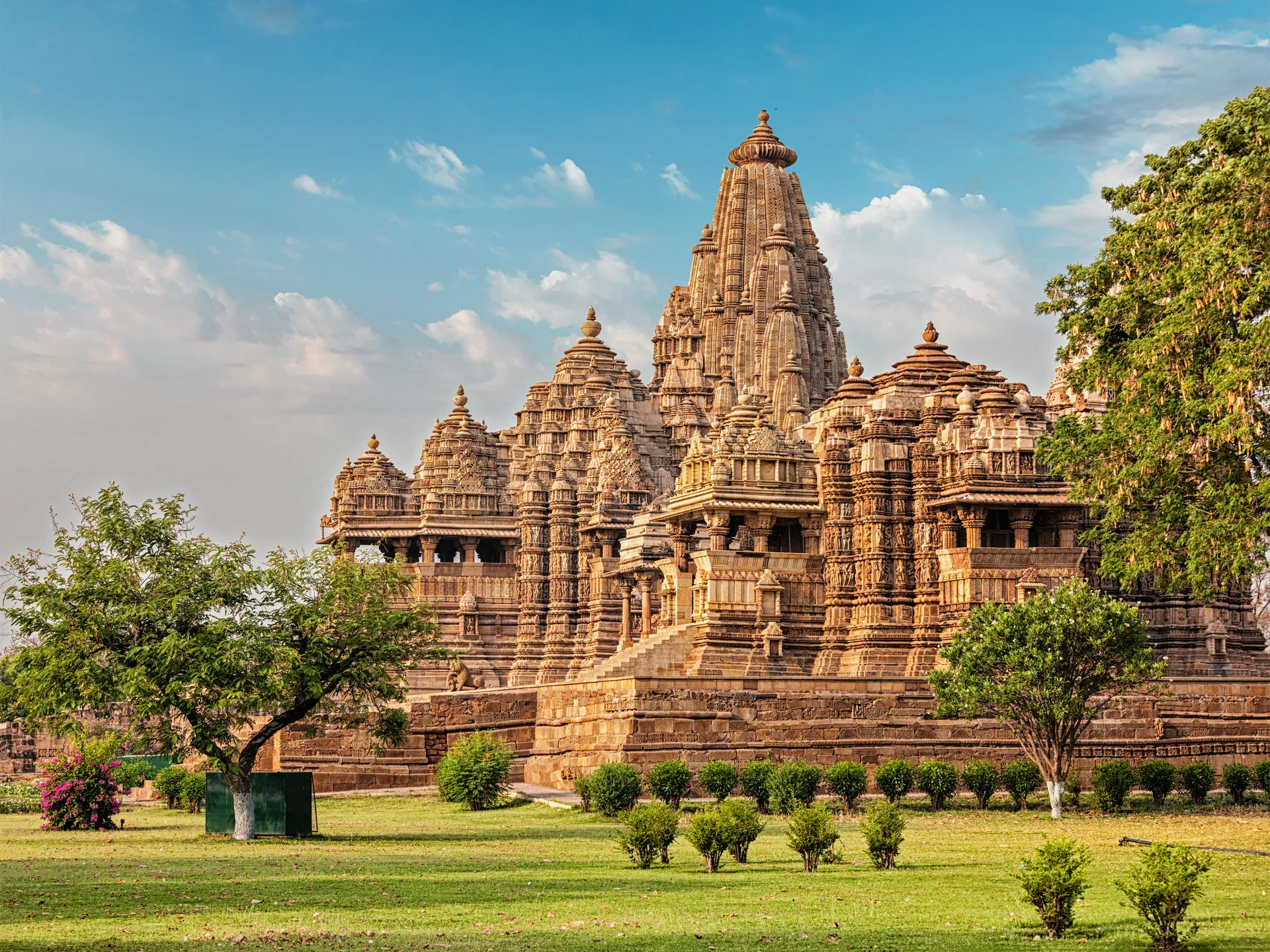
Khajuraho is a mesmerising UNESCO World Heritage Site renowned for its extraordinary group of medieval Hindu and Jain temples, celebrated for their breathtaking Nagara-style architecture and intricate, sensual sculptures. Built primarily between 950 and 1050 CE during the golden age of the Chandela dynasty (who ruled much of central India), Khajuraho once boasted around 85 temples spread over 20 square kilometres. Today, about 20-25 survive in remarkable condition across three main clusters – the Western Group (the most famous and best-preserved) the Eastern Group (mostly Jain temples), and the Southern Group.
Upon arrival in Khajuraho, we’ll transfer directly to our hotel, check in and have a bit of time to freshen up before heading out to explore the Western Group of Temples, renowned for their extraordinary carvings depicting deities, musicians, dancers, and scenes of daily life with remarkable vitality.
Dinner tonight is at the hotel.
Overnight: Radisson Hotel Jass, Khajuraho (B, L, D)
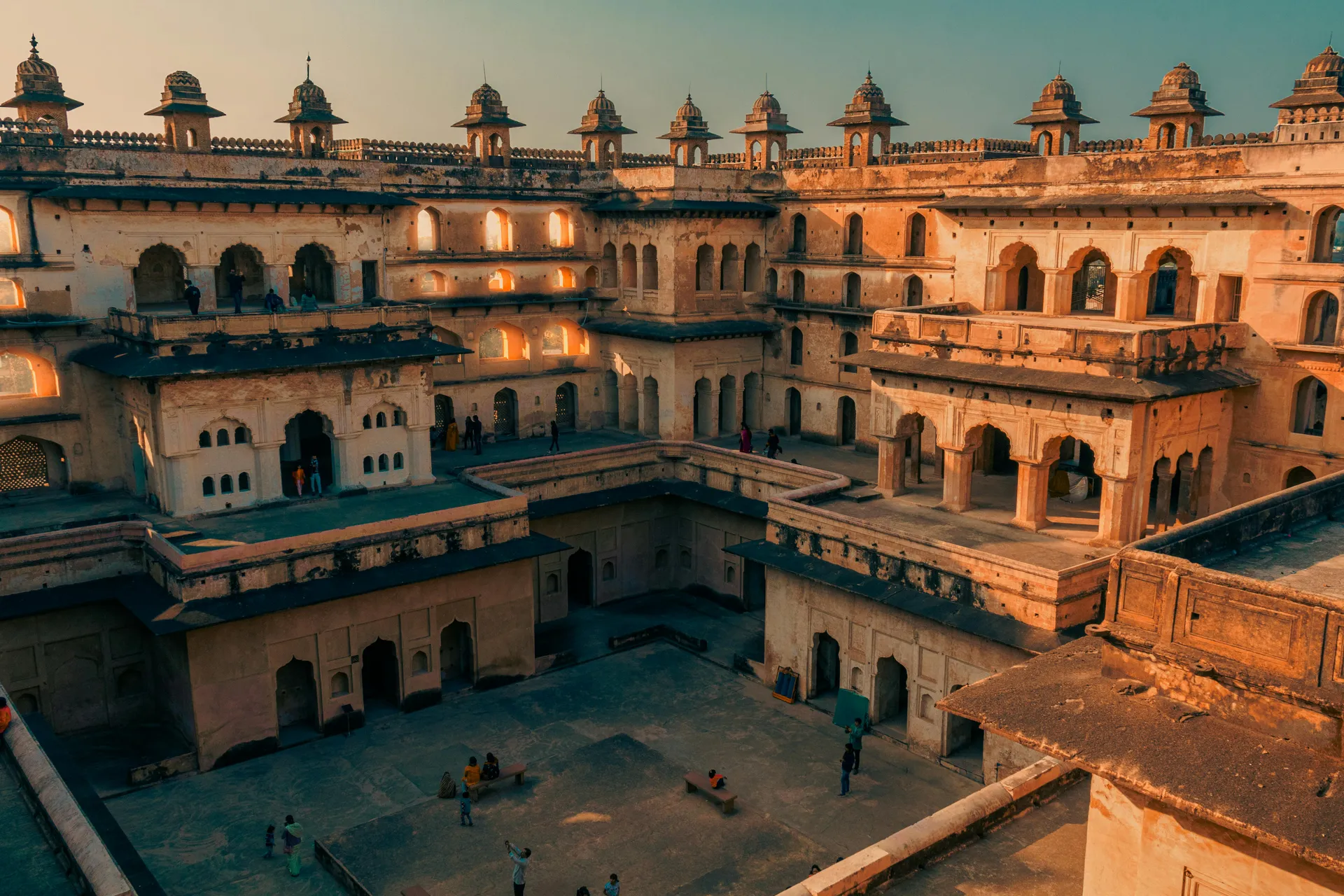
This morning after breakfast and check out, we’ll drive to Orchha, a hidden historic gem nestled on the banks of the Betwa River. Founded in the early 16th century, it served as the capital of the Bundela kingdom and had close ties with the Mughal Empire. While it faded into relative obscurity, it has been preserved remarkably well, with many monuments still standing amid lush surroundings.
Here, we’ll visit the Orchha Fort Complex – a sprawling group of palaces, temples, and structures enclosed within fortified walls showcasing grand gateways, intricate frescoes, arched corridors, and towers, with a harmonious fusion of Hindu Rajput elements and Islamic Mughal influences. Highlights include the Jahangir Mahal, known for its blend of delicate carvings and robust architecture; the Raj Mahal, famous for its vibrant murals depicting religious themes; and the Rai Parveen Mahal, dedicated to the 17th-century poetess and musician.
We’ll pause for lunch at leisure before continuing on to Jhansi, our home for the night. After checking in, there’ll be time to freshen up before gathering for dinner together in the hotel restaurant.
Overnight: Nataraj Sarovar Portico, Jhansi (B, D)
After a leisurely breakfast and checkout, we’ll transfer to the Jhansi railway station to take our Executive Class seats on the Shatabdi Express to Bhopal, arriving in the early afternoon. You’ll enjoy a simple lunch on the train as you roll through the agricultural landscape.
Upon arrival, we’ll transfer directly to our hotel and check in. Perched on the vibrant slopes of Shamla Hills, the historic and majestic Jehan Numa Palace Hotel in Bhopal is a stunning blend of British Colonial, Italian Renaissance, and Classical Greek architecture. After a few hours to relax, or get out and about on your own, we’ll regroup for dinner in the hotel.
Bhopal is a fascinating blend of history, culture, nature, and modernity, where the old city’s bustling markets and regal architecture meet the modern city’s wide boulevards and contemporary charm. Often called the “City of Lakes” due to its large water bodies, and the “City of Begums” for its unique history of female rulers, it’s one of India’s greener and more laid-back major cities. Founded in the 11th century, it rose to prominence as a princely state. From 1819 to 1926, it was ruled by a succession of remarkable women – the Begums – who governed progressively for over a century. They promoted education, infrastructure, and women’s rights in an era when female leadership was rare. This legacy gives Bhopal a strong matriarchal cultural imprint. The city also carries the tragic memory of the 1984 Bhopal gas tragedy (Union Carbide disaster), one of the world’s worst industrial accidents, which still influences discussions on safety and corporate responsibility.
Overnight: The Jehan Numa Palace, Bhopal (B, L, D)
This morning after breakfast, we’ll head out to explore the fascinating history of this part of central India, starting with a drive out to Sanchi, home to one of the world’s most important Buddhist heritage sites – the Buddhist Monuments at Sanchi. This UNESCO World Heritage Site is a remarkable collection of stupas, monasteries, temples, and pillars dating back more than 2,000 years, offering an unparalleled glimpse into early Buddhism. The star attraction here – the Great Stupa I, built by Emperor Ashoka to establish the centre in the 3rd century BC – contains relics of Buddha such as teeth, hair, and shoulder bones.
From here, we’ll drive on to the Udayagiri Caves, a fascinating group of 20 rock-cut caves dating back to 320–606 AD. Carved into a sandstone hill, the caves represent some of the earliest surviving examples of Hindu rock-cut architecture and temple sculpture. Highlights include a massive, dramatic relief of Vishnu as Varaha (the boar avatar) lifting the earth goddess Bhudevi from the cosmic ocean in Varaha Cave – the most iconic of the caves; Sheshashayi Vishnu, home to the poignant relief of Vishnu reclining on the serpent Ananta in cosmic sleep, with Lakshmi at his feet; and the intricate relief showing the mythological event where gods and demons churn the ocean for nectar in Cave 19.
After returning to our hotel, the rest of the afternoon and evening are
at leisure.
Overnight: The Jehan Numa Palace, Bhopal (B)
This morning after breakfast and checkout, we’ll transfer to the railway station to board the Vande Bharat Express to Nagpur, the gateway to the Pench National Park, our destination for today. A packed lunch will be served on the train.
Upon arrival in Nagpur, we’ll embark on a scenic road journey to Pench National Park, nestled in the southern reaches of Madhya Pradesh and home to the majestic Royal Bengal Tiger, along with a rich diversity of wildlife including jackals, wild dogs, wild boars, sloth bears, Indian leopards, and striped hyenas. Widely considered the primary real-life inspiration for Rudyard Kipling’s “The Jungle Book”, with its Seoni region forests, Pench River, and wildlife matching descriptions in the classic tales, the park’s landscapes, including teak forests, valleys, and streams, directly echo Mowgli’s world, making it fondly known as “Kipling Country”.
On arrival, check into our accommodation set in fifty acres of lush foliage, sprawling lawns and untouched landscapes. After some time to relax amidst the tranquil surroundings, we’ll enjoy dinner together.
Overnight: Pench Jungle Camp, Pench National Park (B, L,D)
Your stay at the Pench Jungle Camp is an immersive one, including breakfast, lunch and dinner each day, and two jeep safari experiences. Various other activities are available at leisure including stargazing with a guide, wildlife presentations, eco walks, a visit to a nearby potter’s village, etc. – many of these are complimentary.
Early this morning, we’ll embark on a thrilling jeep safari at a time when the animals are most likely to be out and active. The comfortable open jeeps ensure you have the maximum opportunity to spot any number of wildlife as the forest comes alive.
You’ll be back at the Camp in time for a hearty late breakfast.
The bulk of the day is yours – you might like to enjoy the camp’s extensive facilities or head out on an excursion of your choosing. Later in the afternoon, we’ll head out on our second jeep safari for another opportunity to spot tigers, leopards, sloth bears, and a variety of birds.
Dinner tonight is at the lodge.
Overnight: Pench Jungle Camp, Pench National Park (B, L,D)
This morning after breakfast and check out we’ll hit the road to Nagpur airport, about four hours away, to board a flight to Mumbai. Enjoy a simple lunch onboard the flight.
The capital of the Indian state of Maharashtra, Mumbai is a vibrant and pulsating cosmopolitan that represents the face of modern India. A cluster of seven islands that was presented to King Charles II as dowry in 1661, Mumbai today has become the economic capital of the country with thriving markets and business houses.
The coexistence of several different communities here reflects the multi-ethnic identity of a city that never sleeps.
Upon arrival in the early afternoon, we’ll transfer directly to our hotel, check in, and enjoy a few hours at leisure. You may like to explore the Gateway of India near the hotel – Mumbai’s iconic 26-metre triumphal arch, built in 1911 to commemorate King George V and Queen Mary’s visit. This colonial landmark also marked the departure of the last British ship in 1947, symbolising the end of the British Raj.
Tonight, we’ll celebrate the end of our Indian adventure journey with a farewell dinner including drinks at one of Mumbai’s finest restaurants.
Overnight: Taj Mahal Tower, Mumbai (B, L, D)
After breakfast this morning, we’ll embark on a curated tour of Mumbai’s cultural highlights, starting with a drive-through tour of the Kala Ghoda Art District – home to heritage buildings, quaint restaurants, museums, theatres, and art galleries, it’s a vibrant blend of Mumbai’s artistic heritage.
You’ll visit the historic, UNESCO World Heritage listed Chhatrapati Shivaji Maharaj Terminus. Originally named Victoria Terminus in honor of the Queen, reflecting Bombay’s (now Mumbai’s) status as a key British colonial port, it is one of India’s most iconic landmarks and often hailed as one of the world’s most beautiful train stations – a true architectural marvel in the High Victorian Gothic Revival style. We’ll continue to the Church Gate Station and board a local train for a short ride to Mahalakshmi Station, another one of Mumbai’s busiest hubs on the local train network, so you can experience the life of a typical Mumbaikar! From here we’ll walk to the viewing deck of Dhobi Ghat, one of the city’s most iconic and photogenic landmarks – an enormous open-air laundry that’s often called the world’s largest outdoor laundry. It’s a fascinating glimpse into Mumbai’s everyday life, contrasting the city’s high-rise glamour with traditional, labor-intensive work with hundreds of washermen cleaning clothes in rows of concrete wash pens.
Our next stop will be Mani Bhawan, a historic residence where Mahatma Gandhi stayed between 1917 and 1934. Now a museum, it houses a library, photo gallery, and dioramas depicting Gandhi’s life. We’ll continue on to Malabar Hill, one of Mumbai’s most affluent and hilly neighborhoods and home to the Hanging Gardens, a beautifully terraced garden that serves as a peaceful green oasis amid the city’s hustle. We’ll pause here for a walk on the garden’s nature trail to soak in the panoramic views of the Arabian Sea. There will be time for lunch at leisure along the way.
Our city tour ends with a drive along Mumbai’s Marine Drive featuring numerous Art Deco buildings, many of which were recognised as a UNESCO World Heritage site in 2018.
Our tour ends when we return to the hotel in the early afternoon. Your room will be available until 6.00pm and airport transfers (included in the tour price) will be arranged in accordance with your flight departure time.
If you would like to stay a little longer in Mumbai, please reach out to our office on 1300 800 977 so we can arrange your post-tour accommodation at our hotel.
Taj Mahal Tower, Mumbai (B)
13 nights accommodation in 5-star hotels
2 nights accommodation in a premium Jungle Camp in Pench National Park
Breakfast daily, 9 lunches, 11 dinners
Airport transfers upon arrival and departure
All transport fares and costs provided for in the itinerary
All meals, drinks excursions provided for in the itinerary
Porterage at Railway stations and hotels
Full-time Railway Adventures Tour Leader and Local Tour Manager/Guide throughout
Knowledgeable guides
Accommodation taxes (if applicable)
All service gratuities and tips for guides (valued at $550pp)
Travel to tour departure point and from tour end point
Travel insurance (Mandatory for international travel)
Visa fees
Meals and drinks not provided for in the itinerary
Things of a personal nature such as phone calls, laundry, room service, etc
The best train trips possible, private luxury coach for off-train travel, guided walking where suitable, and other appropriate and appealing options to make exploration easy
Hand-picked hotels and resorts based on location, customer feedback, value and atmosphere. Please Note: Hotels of a similar standard may be substituted.
Hear from some of our adventurers that have already ridden the rails with us.
Lorem ipsum dolor sit amet consectetur. Tincidunt convallis magna eu ac eu cursus. In duis fusce risus nec eget habitant massa pharetra. Eros a gravida faucibus lorem.

Reserve your place on this exciting exploration of The Splendours of Central India by Rail.

Train traveller, well known TV personality and travel company owner, Scott McGregor, has travelled on some of the world’s most inspiring railway tours and led the most exclusive group adventures to numerous exotic destinations over the years.
“Rustic, character-filled, zig-zagging railways of Burma, opulent hotels on wheels in India South Africa and Sri Lanka, steam-hauled heritage trains in some of the most staggeringly scenic parts of the world, dinky little rail-cars in outback Queensland, bullet trains in Japan, cliff-hugging lines in Switzerland and Norway—if it travels on a rail track, I’m there!”, exclaims self-confessed train travel tragic, Scott McGregor. “In my mind, travelling by rail is still the most wonderful way to immerse yourself in the country you’re visiting. It’s romantic, relaxing and about as much fun as you can have!”.
Aa a child of the last days of steam trains in the busy junction town of Orange, NSW; trains heading in all directions offering temptations and dreams of faraway places, left an indelible impression on a young, inquisitive boy and Scott has been riding the rails in one form or another ever since. While Scott’s acting career of 30 years kept him busy starring in numerous TV shows and stage plays and then as an on-air presenter on programs such as Better Homes and Gardens, Room for Improvement and various pay-TV programs, his passion for railway tours was ever-present. “Presenting a series of Railway Adventure travel programs for Channel 7 was a career highlight”, he says with as much enthusiasm now as he had then.
In 2012 Scott decided to combine three of his passions; travel, trains and presenting, and launched Railway Adventures. Not only does he get to expand his own horizons and indulge his love of train travel, he gets to use his extensive hosting experience and love of people to lead other like-minded travellers on escorted train tours around the world. Since then, Railway Adventures has mounted more than 50 tours from Sweden to Sri Lanka, Tasmania to Transylvania, Britain to Burma and Venice to Vietnam, thrilling over 1,000 travellers. New tours are launched regularly, inspired by new trains, new routes and the growing interest in taking a train to some of the world’s most fascinating places. But you don’t have to be a train ‘nut’ to enjoy a Railway Adventures tour – there’s something for everyone!
Just one example of how Scott finds inspiration for a tour can be found in Outback Queensland. “There you find some of Australia’s most eccentric and appealing trains and together with a mail-plane flight over the Gulf and some interesting local coach and boat trips you have the essence of a quintessential Aussie outback adventure. The sleeper train, The Spirit of the Outback, the Savannahlander and the Gulflander (which has been running on the same timetable for more than 125 years!) are all iconic trains that traverse various parts of the wild Outback, Savannah and tropical rainforest landscapes of the vast state of Queensland. Along with some other special treats not available to the ordinary traveller, Railway Adventures passengers get to do it all!.
One of his favourite journey’s is by private train in Sri Lanka. For 2 weeks every year Scott charters the Viceroy Special heritage train to tour the island on a gentle rail cruise with a lucky group of travellers. Staying in luxury resorts and hotels along the way, his special train travels to almost every corner of the scenic island. “Having a private train at your disposal for an adventure around this magic island is a rare treat and a great way to immerse yourself in the scenery and culture of the country.”, he enthuses. “Our Vietnam tour makes use of private carriages attached to regular trains to explore that great country in comfort and in South Africa we use a variety of trains including the luxurious Rovos Rail and the Royal Livingstone steam train to move from one incredible adventure to another”.
Apart from the obvious joy of seeing a country by train, travelling in a small group of like-minded travellers with a dedicated, experienced tour leader and knowledgeable, English-speaking local guides is what really sets Railway Adventures apart. “The camaraderie that comes from both shared purpose and shared experiences on tour is an important aspect of the journey” Scott adds. “We’ve seen many people become life-long friends from the time they shared together along the line. The best feeling in the world is when I welcome these same people on repeat journeys”.
Along with popular destinations like Switzerland, Scandinavia, Outback Queensland and Sri Lanka, a new breed of more unusual destinations has gained great interest. Java, Cuba, Southern Africa, India and the New England region of NSW are just some of the newer adventures on offer. As for Scott’s next escape, it’s most likely some quality time at Ruwenzori Retreat, his own personal train on the Great Dividing Range near Mudgee, Central NSW. Built from a collection of vintage railway carriages it’s now a boutique tourist accommodation, comprising exclusive Orient Express style comfort for up to 13 guests. “When the travels are done, coming back to my own train in the beautiful Mudgee mountains is the most restorative and magical time for this committed rail romantic”, Scott says.